
Saudi Wage Protection System (WPS): Step-by-Step Compliance Guide for Mudad
Master Madad WPS compliance in Saudi Arabia. Learn file specs, reconciliation, penalty triggers, and automated payroll workflows for KSA entities.

Saudi Wage Protection System (WPS): Step-by-Step Compliance Guide for Mudad
Operating an enterprise in the Kingdom of Saudi Arabia (KSA) requires strict alignment with the regulatory infrastructure designed by the Ministry of Human Resources and Social Development (MHRSD). At the center of this framework is the Saudi Wage Protection System (WPS), mandated to guarantee that private-sector workers receive agreed-upon wages on time and in full.
Today, handling payroll in the Kingdom centers on Mudad—the official financial and compliance platform linking employers, local commercial banks, and government oversight portals like Qiwa. Achieving consistent madad wps compliance is no longer merely an administrative chore; it is an existential operational requirement. Failure to align your payroll cycles with Mudad's technical criteria can trigger frozen work permits, labor office sanctions, and substantial financial penalties.
This guide provides CFOs, payroll managers, and People Ops leaders with an operational roadmap to navigate Mudad, structure compliant payroll files, reconcile variances, and leverage automated infrastructure—such as HR Suite by Smart Chain—to eliminate human error.
Understanding the Saudi WPS and the Mudad Ecosystem
The Wage Protection System tracks salary disbursements across all private-sector entities in Saudi Arabia, cross-referencing employment contracts registered on Qiwa against actual bank disbursements processed through the Saudi Central Bank (SAMA) network.
To centralize this monitoring, the MHRSD established Mudad, which operates through two dedicated environments:
- The Compliance System (WPS Portal): Used primarily by medium and large organizations to upload wage files processed through commercial banks, review compliance scores, and respond to regulatory justifications or employee disputes.
- The Payroll Management System: Tailored for small to mid-sized enterprises (SMEs) to initiate payroll directly through Mudad’s payment gateway, issuing disbursements to local accounts without separate banking software.
Maintaining compliance requires every private entity to upload its standard wage file within the regulatory window each month, demonstrating that at least 80% of registered staff receive their baseline contractual wages without unapproved deductions.
Key Technical Specifications for Wage Files
A primary cause of compliance failure is file rejection caused by incorrect syntax or data mismatches. Mudad enforces precise rules for the Standard Information File (SIF) generated by your payroll software.
Required Data Fields
To pass Mudad verification, your wage file must parse the following variables accurately:
- Employer Identification: The 10-digit Ministry of Commerce Unified Number (700 number) and the establishment's Labor Office ID.
- Employee Identification: National ID (for Saudi nationals) or Iqama number (for expatriate staff). Mismatches against Qiwa records cause automatic rejections.
- Bank Details: Valid International Bank Account Numbers (IBAN) matched to the specific employee identifier.
- Salary Breakdown: Explicit line items for basic salary, housing allowance, other allowances, and explicit deductions.
- Payment Metadata: Pay period reference dates and the total file hash count.
Formatting and Validation Rules
- Delimiters: Files must adhere to strict CSV or TXT structures using standard comma separation without trailing delimiters.
- Character Sets: Text inputs (such as employee names or remarks) must be encoded in UTF-8 to prevent Arabic character corruption.
- Zero Values: Optional allowances must be entered as
0.00rather than left blank or recorded as null characters.
| Data Field | Format Requirement | Common Failure Reason |
|---|---|---|
| Employee ID | 10 digits (Iqama/National ID) | Expired Iqama or typo in identity number |
| IBAN | 24 alphanumeric characters (SA...) |
Account number mismatch with beneficiary name |
| Basic Wage | Numeric (0.00) |
Value lower than Qiwa contract baseline |
| Deductions | Numeric (0.00) |
Deductions exceeding 50% statutory cap |
Operational Steps for Madad WPS Compliance
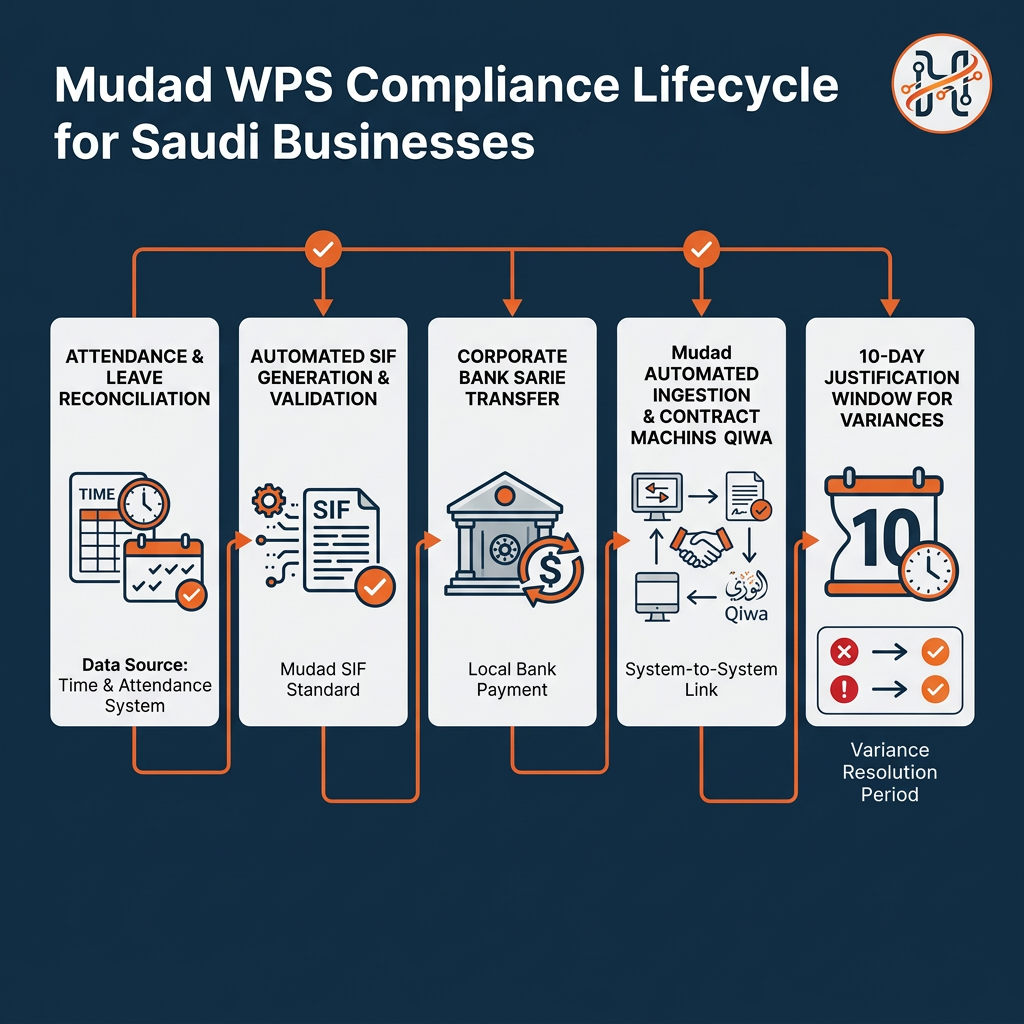
Executing a smooth payroll cycle requires coordinated timing between HR, finance, and Mudad’s ingestion APIs.
Step 1: Attendance and Deduction Finalization
Before compiling the payroll run, reconcile verified working days, unpaid leaves, and authorized disciplinary deductions. Cross-reference attendance records from modern systems (such as biometric logs, QR check-ins, or GPS-tracked field stamps) against Saudi Labor Law deduction limits.
Step 2: SIF Generation via Localized Payroll Software
Run the gross-to-net payroll engine configured for Saudi tax and social insurance frameworks, notably General Organization for Social Insurance (GOSI) deductions. The system must output a formatted SIF matching MHRSD file specifications.
Step 3: Bank Processing
Submit the wage file through your corporate banking portal. Saudi banks validate the file structure, execute real-time SAR transfers via the SARIE network, and generate an acknowledgment receipt containing a unique transaction reference number.
Step 4: Mudad File Reconciliation
For enterprises using commercial bank portals, the bank automatically relays the execution log to Mudad, or the payroll team uploads the bank-validated SIF directly into the Mudad Compliance Portal. The platform cross-checks the data against contracts logged in Qiwa.
Step 5: Discrepancy Justification
If an employee's disbursed wage deviates by more than 20% from their contractual salary, Mudad flags the record. HR must submit formal justifications—such as documentation for unpaid leave, joiner/leaver pro-rations, or statutory deductions—directly in the portal within 10 days.
Critical Penalty Triggers Under Saudi Labor Law
The MHRSD monitors compliance dynamically. Non-compliance is not an end-of-year audit finding; it triggers automated administrative sanctions in real time.
1. The 80% Compliance Threshold
Your company must maintain an aggregate compliance rate of at least 80% across your workforce. If your compliance score drops below this benchmark, the organization is marked non-compliant.
2. Missing the Payment Deadline
Wages must be deposited within the first dynamic cycle determined by the establishment's tier, typically within the first few days following the end of the calendar month. A delay exceeding two consecutive months exposes the business to punitive inspections.
3. Immediate Sanctions Triggered by Mudad
- Month 1 of Non-Compliance: Automated warnings sent via the MHRSD dashboard.
- Month 2 of Non-Compliance: Suspension of recruitment services on Qiwa, preventing the issuance of new work visas.
- Month 3 of Non-Compliance: Complete freeze on foreign worker transfer services, preventing Iqama renewals across the entire enterprise, alongside statutory labor office fines.
How Modern HRMS Platforms Automate KSA Compliance
Managing Mudad compliance manually using spreadsheets invites compounding data risks. A single transposed digit in an Iqama number or an inaccurate deduction formula can corrupt an entire SIF, delaying payroll for hundreds of employees.
Using an intelligent workforce management platform eliminates these vulnerabilities at the source.
- Native GOSI & Saudi Labor Logic: Systems like HR Suite incorporate built-in Saudi compliance packs that automatically compute statutory social insurance, track contract rules, and cap deductions according to KSA regulations.
- Validated SIF Generation: Instead of manually formatting text files, an integrated payroll engine converts approved timesheets and payroll runs directly into a fully compliant SIF, pre-checked against Mudad schema requirements.
- Integrated Time and Leave Records: Unpaid leaves, authorized deductions, and overtime calculated via smart attendance options—including facial recognition, QR verification, and GPS tracking—flow directly into payroll, creating an audit-ready paper trail for any Mudad variance justifications.
- Proactive Document Monitoring: Document monitoring engines track Iqama and passport expirations, notifying HR leadership weeks before document invalidity leads to rejected bank disbursements.
Summary and Next Steps
Navigating madad wps compliance requires operational rigor, a firm grasp of MHRSD data requirements, and continuous reconciliation between attendance, banking, and contract repositories. By moving away from brittle spreadsheets and adopting an end-to-end, multi-country HR and payroll platform, organizations running Saudi operations can guarantee compliance, avoid Qiwa service locks, and maintain an uninterrupted operational cadence.
Ready to eliminate compliance errors and automate your KSA payroll operations? Discover how HR Suite centralizes employee lifecycles, attendance, and compliant payroll runs across your Saudi entities. Start your 14-day free trial today.
Streamline your KSA payroll and guarantee 100% Mudad compliance. Start your 14-day free trial of HR Suite by Smart Chain today.
Frequently asked questions
What is the minimum compliance percentage required on Mudad WPS?
Under MHRSD guidelines, an establishment must maintain an overall compliance rate of at least 80% of its workforce. Falling below this threshold triggers regulatory scrutiny and potential service suspensions.
How long does an employer have to justify salary variances in Mudad?
Employers typically have 10 calendar days from the date a salary deduction or discrepancy is flagged to submit formal justifications and supporting documentation directly within the Mudad portal.
What happens if an establishment fails to upload its wage file on time?
Failing to submit payroll records leads to immediate automated warnings. After two months of non-compliance, Qiwa work visa issuance is frozen; by month three, all employee transfer and Iqama renewal services are suspended alongside labor office fines.
How does HR Suite help with Mudad WPS compliance?
HR Suite by Smart Chain automates gross-to-net payroll using built-in Saudi Labor Law rules and GOSI rates. It outputs verified, properly delimited SIF files ready for upload and connects attendance directly to payroll calculations to prevent unverified salary variances.