How to Simplify Payroll Management with Automated HR Software
Streamline payroll runs, salary allowances, deductions, and UAE WPS SIF compliance with intelligent payroll management software. Eliminate manual errors today.

How to Simplify Payroll Management with Automated HR Software
For growing organizations, processing monthly payroll often feels like navigating a minefield. Managing multiple shifts, tracking variable allowances, calculating deductions, adjusting for mid-month leaves, and formatting region-specific compliance files can easily overwhelm finance and people operations teams. When payroll relies on manual spreadsheets and fragmented emails, a single broken cell reference or miscalculated absence can trigger employee dissatisfaction or severe regulatory penalties.
Modern enterprises require resilience and automation. Adopting purpose-built payroll management software unifies core HR data, time tracking, and compensation rules into an automated, error-free workflow. With platforms like HR Suite by Smart Chain, businesses can execute payroll cycles in minutes while maintaining stringent compliance across jurisdictions.
Here is how deploying dedicated payroll software simplifies workforce compensation, improves operational efficiency, and ensures continuous legal adherence.
The Operational Friction of Manual Payroll Systems
Before analyzing automation benefits, it is crucial to recognize where legacy payroll systems fail. In many organizations, HR records, biometric clock-ins, leave requests, and finance databases exist in departmental silos.
- Formula Fragility: Spreadsheets lack robust governance. Unintentional formula overwrites or copy-paste errors compound month after month.
- Disjointed Time & Attendance: Pulling raw clock-in data from biometric devices and cross-referencing unpaid leaves manually consumes hours of HR administrative bandwidth.
- Compliance Vulnerabilities: Failing to adapt formulas to changing regulatory frameworks—such as updated social security contributions or regional Wage Protection Systems—exposes businesses to fines and license blocks.
- Audit Gaps: Disconnected spreadsheets do not provide immutable audit trails. Identifying who altered an allowance, when a deduction was applied, or who approved an overtime adjustment becomes nearly impossible.
Transitioning to integrated HR management software eliminates these friction points by synchronizing payroll calculations directly with verified workforce data.
Key Pillars of Modern Payroll Management Software
Automating compensation involves more than applying gross-to-net calculations. Robust payroll management software serves as an operational hub connecting compensation structures, workforce schedules, approvals, and compliance policies.
1. Unified Salary Components: Dynamic Allowances and Deductions
Every organization uses distinct compensation packages. Standardizing basic salary alongside housing allowances, transport stipends, cost-of-living adjustments, sales commissions, and discretionary bonuses requires modular architecture.
Automated systems enable HR to:
- Predefine recurring allowances and recurring deductions at the contract level.
- Apply one-time variable incentives or disciplinary deductions without altering the base structure.
- Automatically prorate earnings for employees joining or exiting mid-cycle based on precise daily rates.
2. Native Synchronization with Time, Attendance, and Leave
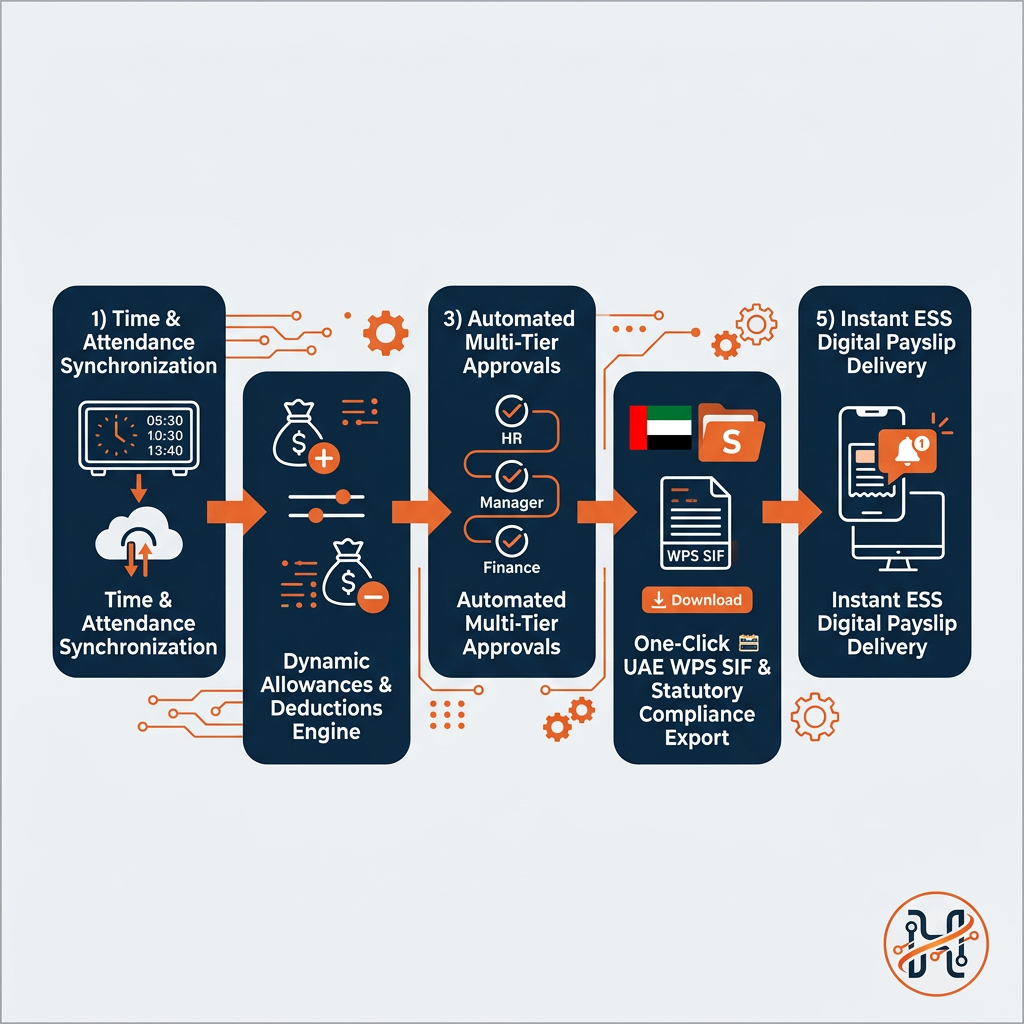
A major bottleneck in payroll processing is reconciliation with attendance logs. Integrated software links the payroll engine directly with smart clock-in methods—such as facial recognition, QR codes, GPS geofencing, and biometric hardware.
When an employee takes approved unpaid leave, arrives late beyond the company grace period, or works authorized overtime, the payroll engine updates calculations automatically. This live bridge removes days of manual spreadsheet auditing.
3. Multi-Tier Approval Workflows
Financial governance requires segregation of duties. Modern software incorporates multi-level approval hierarchies. Once HR initiates a payroll run, automated notifications route the draft to Department Heads, the Finance Director, and the CFO. Approvers can inspect variance summaries, review itemized adjustments, and authorize disbursements with full digital timestamps.
Navigating Regional Compliance: UAE WPS SIF Generation and Gratuity
For companies operating in the GCC—particularly the United Arab Emirates—payroll operations must comply with rigorous statutory mandates. A failure in compliance can halt business operations.
Automated UAE WPS SIF Generation
Under the UAE Ministry of Human Resources and Emiratisation (MOHRE), private sector employers must disburse salaries through the Wages Protection System (WPS). This requires generating a Salary Information File (SIF) matching strict formatting standards, including routing codes, employer unique IDs, employee labor cards, and account numbers.
Manually formatting .SIF text files in spreadsheets frequently causes file rejections due to trailing spaces, misplaced commas, or mismatched salary breakdowns. Automated payroll software generates validation-checked, 100% compliant SIF exports with a single click, protecting the business from MOHRE fines and labor permit blocks.
Accurate End-of-Service (EOS) Gratuity Computations
Calculating End-of-Service gratuity under UAE Labor Law (Federal Decree-Law No. 33 of 2021) or Saudi Labor Law requires evaluating tenure, contract type (limited vs. unlimited where historically applicable), resignation vs. termination conditions, and basic salary exclusions. Modern platforms calculate EOS accruals continuously, projecting liabilities on balance sheets and automatically issuing accurate settlement sheets during offboarding.
Manual Spreadsheets vs. Dedicated Payroll Management Software
| Capability | Legacy Spreadsheets | Automated Payroll Management Software |
|---|---|---|
| Data Integration | Manual export/import from punch clocks & emails | Direct synchronization with attendance, leave, and profiles |
| Human Error Risk | High; broken formulas, untracked cell edits | Zero calculation variance; standardized business logic |
| Processing Speed | 3 to 7 business days per cycle | Minutes from draft creation to approval |
| Regional Compliance | Manual text file formatting for UAE WPS / SIF | Instant compliant SIF export and automated EOS rules |
| Auditability | Fragmented version histories | Immutable digital logs of every modification and approval |
| Employee Experience | Paper slips or manually emailed PDF attachments | Instant mobile/web access via employee self-service |
Digital Payslips and Employee Self-Service (ESS)
Payroll simplification extends to the employee experience. Traditional payroll operations leave HR teams answering routine queries: "Why was my transport allowance adjusted?" or "Can you reissue my payslip from three months ago?"
Through an Employee Self-Service workspace, staff gain on-demand access to:
- Itemized digital payslips detailing basic salary, allowances, deductions, and tax/social security contributions.
- Historical payout archives downloadable for visa or banking applications.
- Live visibility into leave balances, time tracking logs, and expense reimbursements.
Empowering employees with self-service transparency reduces internal HR tickets by up to 60%, allowing HR specialists to focus on strategic organizational initiatives.
Actionable Payroll Reporting for Executive Decision-Making
Payroll is typically an organization's single largest operational expenditure. Leadership teams cannot wait until month-end ledger closings to understand workforce costs.
Modern payroll management software provides instant business intelligence:
- Departmental Cost Allocation: Break down total compensation by division, project, or legal entity.
- Variance Analysis: Instantly review month-over-month fluctuations to spot unexplained overtime spikes or sudden allowance increases.
- Workforce Health Diagnostics: Track headcount growth against payroll spend, identifying operational inefficiencies before they impact operating margins.
Transforming Compensation Operations with HR Suite
Payroll management does not need to be a stressful, labor-intensive monthly ordeal. By replacing error-prone spreadsheets with HR Suite by Smart Chain, organizations unify attendance, variable allowances, multi-tier approvals, and statutory compliance into a single automated ecosystem.
Whether generating UAE WPS SIF files, calculating complex End-of-Service settlements across multi-country entities, or empowering employees with digital payslips, HR Suite delivers the precision and governance modern businesses need to scale.
Ready to streamline your payroll processing? Start your 14-day free trial with HR Suite or contact our product specialists today to schedule a live operational walkthrough.
Ready to streamline your payroll processing and eliminate compliance headaches? Start your 14-day free trial with HR Suite by Smart Chain or contact our specialists for a personalized demo.
Frequently asked questions
What is UAE WPS SIF export, and why is it essential?
The UAE Wages Protection System (WPS) requires employers to pay salaries through authorized financial institutions using a standardized Salary Information File (.SIF). Automated payroll software automatically generates correctly formatted SIF files, preventing costly formatting errors, file rejections, and administrative penalties from MOHRE.
How does payroll management software handle End-of-Service (EOS) calculations?
The software automatically calculates statutory gratuity based on jurisdiction-specific formulas (e.g., UAE or Saudi Labor Law). It accounts for total continuous service tenure, contract classification, base salary components, and departure circumstances (resignation vs. termination), ensuring accurate final settlements.
Can payroll software accommodate complex shifts and variable allowances?
Yes. Modern payroll management systems connect directly with multi-channel attendance records (biometric devices, facial recognition, GPS geofencing) to factor in shift premiums, authorized overtime, unpaid absences, and dynamic allowances without manual spreadsheet manipulation.
Can multi-country organizations manage distinct payroll rules on one platform?
Yes. Platforms like HR Suite support multi-company and multi-country setups with localized compliance packs, allowing businesses to run payroll across regions like the UAE, Saudi Arabia, Egypt, the UK, and beyond under their respective labor laws.