How AI-Powered HR Software Is Transforming Modern Workforce Management
Explore how AI HR software automates recruitment, employee workflows, document intelligence, and compliance to modernize total workforce management.
How AI-Powered HR Software Is Transforming Modern Workforce Management
Human resources operations have reached an inflection point. For decades, HR teams have carried the operational weight of fragmented spreadsheets, disparate databases, and repetitive clerical tasks. Between parsing hundreds of CVs, reconciling attendance logs across distributed shifts, manually drafting employment letters, and tracking document expiry dates, strategic talent initiatives are consistently crowded out by operational administrative drag.
Modern workforce management demands an intelligent operational core. This is where modern AI HR software is reshaping organizational agility. Rather than acting as a passive digital filing cabinet, an AI-native human resources management system actively assists HR leaders, operations managers, and business executives in running streamlined, compliant, and data-informed organizations.
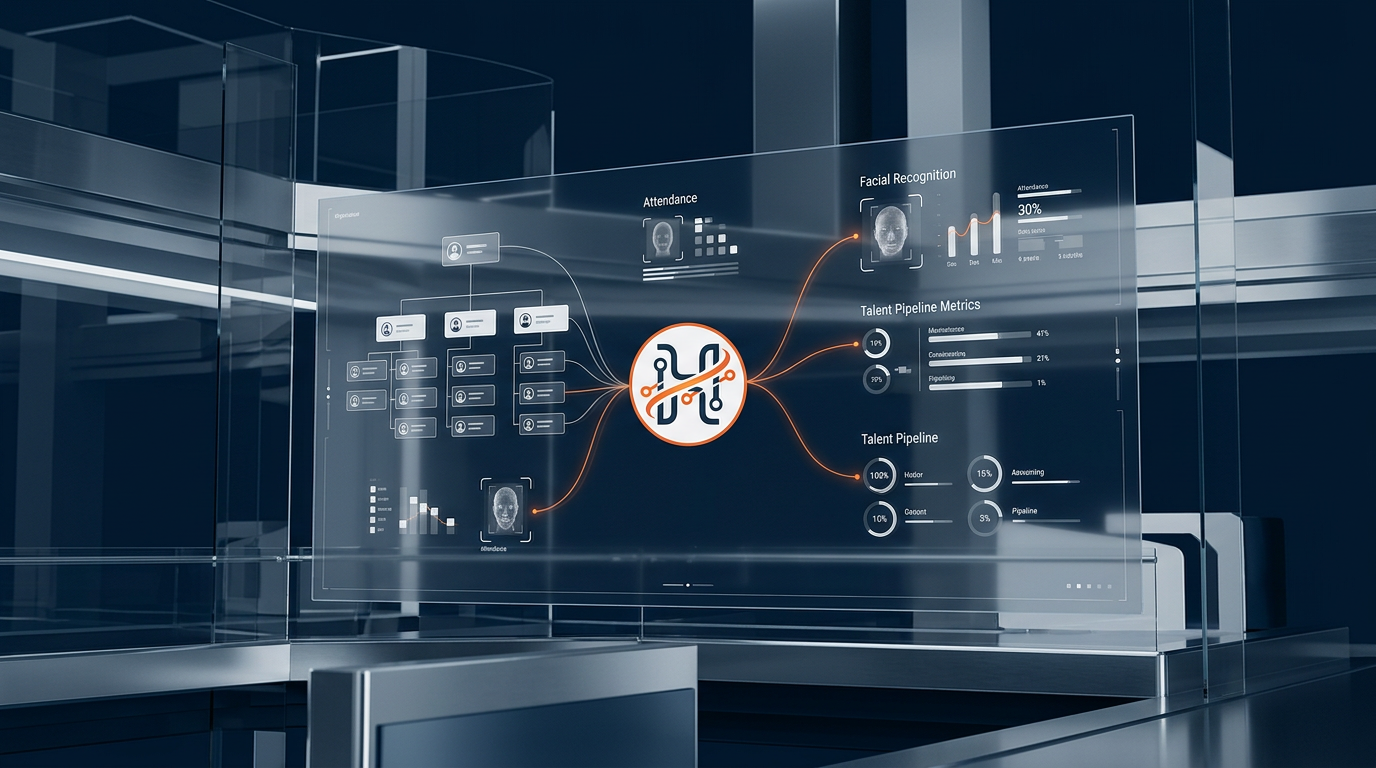
Designed from the ground up to solve these systemic bottlenecks, HR Suite by Smart Chain connects daily people operations with practical machine intelligence, delivering a unified platform for the complete employee lifecycle.
The Evolution from Static HRMS to Intelligent AI HR Software
Traditional HR management software (HRMS) primarily digitized paper-based bureaucracy. It gave organizations digital records, basic forms, and centralized database tables, but it left the cognitive labor entirely to human administrators. An HR specialist still had to read every line of a resume, manually calculate end-of-service entitlements, draft standard letters by hand, and audit attendance anomalies one by one.
In contrast, modern AI HR software introduces an intelligent automation layer directly into routine workflows. According to workplace research from McKinsey & Company, organizational automation and embedded intelligence consistently free internal teams from high-volume administrative tasks, allowing human capital practitioners to focus on organizational design, culture, and high-impact talent engagement.
| Capability Dimension | Legacy HRMS Platforms | Modern AI HR Software (HR Suite) |
|---|---|---|
| Recruitment Screening | Manual reading of incoming PDF/Word CVs | Automated parsing, semantic analysis, and candidate scoring |
| Attendance Tracking | Disconnected punch clocks or unverified forms | Facial recognition, QR verification, GPS geofencing, and anti-spoofing |
| Document Handling | Manual folder organization and calendar alerts | AI document scanning, automated data extraction, and proactive alerts |
| Administrative Output | Manual drafting of HR letters and job briefs | One-click AI letter drafting and role profile generation |
| Workforce Health | Lagging, monthly static reports | Continuous, color-coded health indicators and predictive alerts |
Streamlining Talent Acquisition with AI Recruitment
Recruiting top talent is often slowed down by manual screening bottlenecks. When high-volume job requisitions yield hundreds of applications, recruiters face administrative fatigue, leading to prolonged time-to-hire metrics and missed candidate engagement windows.
Automated Resume Parsing and Candidate Scoring
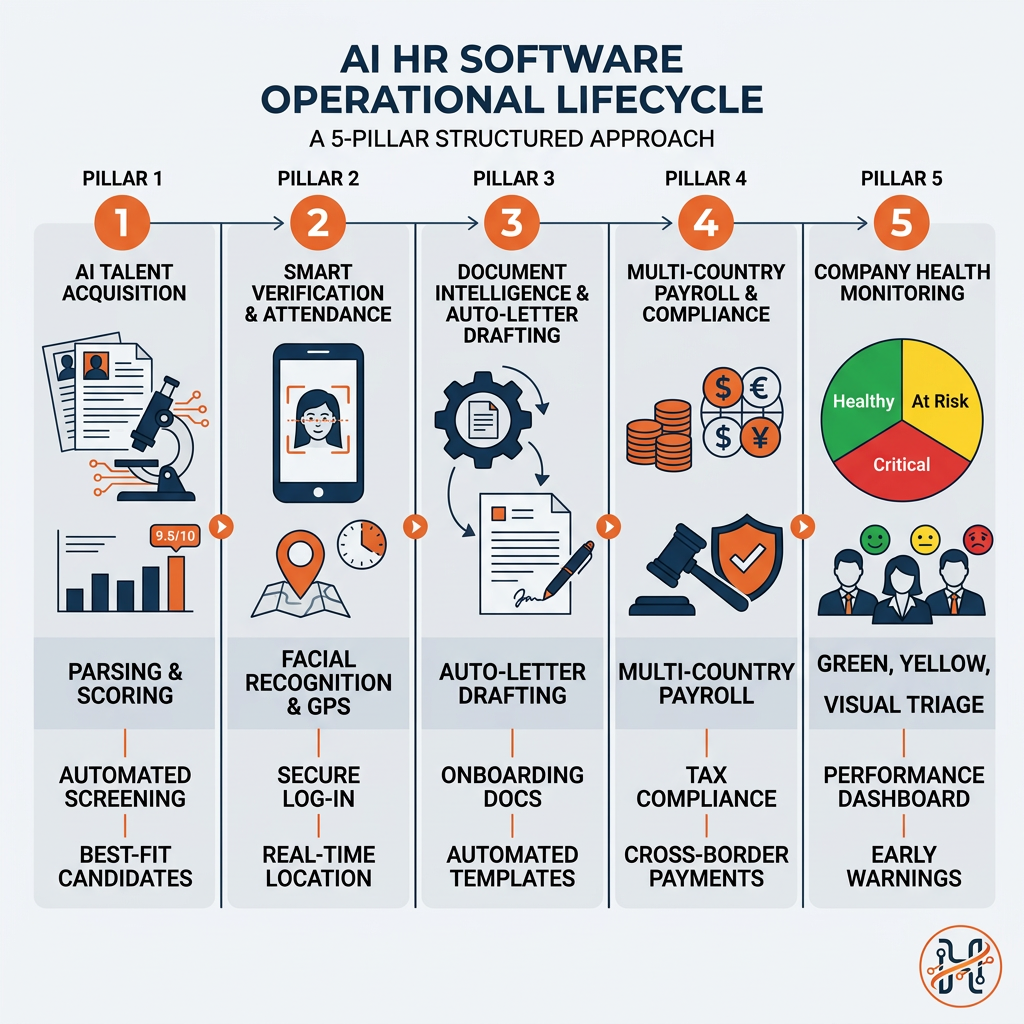
Modern recruitment software embeds artificial intelligence directly into the sourcing and screening funnel. The platform automatically extracts structural data from incoming resumes—regardless of layout—evaluating candidates against required qualifications, industry certifications, and specific job parameters.
Instead of skimming stacks of resumes, hiring managers receive an objectively ranked shortlist based on contextual candidate scoring. This methodology standardizes top-of-funnel evaluation and eliminates subjective screening oversights.
AI Interview Assistance and Structured Evaluation
Beyond initial screening, AI capabilities support the interview lifecycle. Intelligent workflows assist hiring teams by generating role-specific, competency-based interview questions tailored to the candidate's background and identified qualification gaps. Standardized scoring templates help cross-functional interview panels assess responses objectively, accelerating the transition from first interview to formal job offer.
Discover how an integrated applicant pipeline works by exploring HR Suite's complete feature set.
Everyday Employee Management and Document Intelligence
Employee management involves substantial transactional documentation. From onboarding verifications to visa tracking and ongoing personnel requests, operational momentum stalls when documentation is scattered across localized desktop folders and email threads.
Proactive Document Processing and Expiry Management
Managing corporate compliance requires strict oversight of employee records, including national identification cards, passports, visas, trade certifications, and employment agreements. Research published by SHRM highlights that administrative compliance oversights represent a persistent operational liability for fast-scaling enterprises.
AI HR software resolves this friction by deploying document intelligence to:
- Automatically scan and extract critical identity data during onboarding.
- Classify documents into secure, centralized personnel profiles.
- Run continuous expiry audits, generating proactive renewal workflows before compliance breaches or operational interruptions occur.
Automated HR Letter Generation
Drafting standard administrative correspondence—salary verification certificates, bank opening letters, embassy NOCs, and formal promotion notices—often consumes hours of manual word processing each week. Modern platforms leverage automated letter generation engines that pull dynamic verified employee tokens directly from the core HR database. HR teams review and approve legally structured, brand-compliant documentation in seconds.
Modernizing Attendance and Field Workforce Operations
Hybrid work models, field operations, shift scheduling, and distributed job sites present significant operational challenges for traditional attendance logging. Manual timesheets and unverified clock-ins lead to inaccurate payroll allocations, administrative reconciliation overhead, and potential payroll disputes.
HR Suite addresses modern attendance management across diverse workforce setups by unifying multiple clock-in channels:
- Facial Recognition Attendance: Biometric verification that mitigates buddy punching and time theft on job sites or office entrances.
- QR Code and GPS Geofencing: Dynamic QR scanning and GPS-verified mobile check-ins tailored for field technicians, logistics drivers, and remote site teams.
- Web and Hardware Biometrics: Native web attendance consoles integrated directly with external biometric hardware devices.
By consolidating attendance tracking into an automated system, hours worked, overtime hours, and absence adjustments synchronize automatically with payroll calculations without requiring manual spreadsheet imports.
Continuous Performance Reviews and Company Health Monitoring
Annual performance evaluations often fail to capture practical day-to-day employee contributions, typically resulting in delayed feedback and disconnected organizational priorities. Contemporary AI HR software transitions organizations toward continuous performance alignment.
Real-Time Performance Tracking
Through unified performance modules, organizations facilitate structured one-on-one sessions, milestone check-ins, and automated goal tracking. Managers maintain continuous alignment with departmental OKRs without drowning in administrative review forms.
Company Health Monitoring
To help operational leaders spot systemic issues early, HR Suite incorporates a visual Company Health Monitor. Rather than requiring management to parse complex analytics dashboards, the system displays core operational health metrics through a clear visual indicator framework:
- 🟢 Green (Healthy / On Track): Attendance patterns, leave utilization, and documentation compliance are within optimal operational parameters.
- 🟡 Yellow (Requires Attention): Emerging attendance trends, approaching document expirations, or pending approval bottlenecks detected.
- 🔴 Red (Requires Immediate Action): Critical compliance issues, expired employee legal documents, or unaddressed operational escalations.
Multi-Country Compliance, Payroll, and End-of-Service Management
As organizations expand internationally, human resources complexity compounds exponentially. Operating across markets like the UAE, Saudi Arabia (KSA), Egypt, the UK, the US, India, or Pakistan means managing distinct legal frameworks, wage regulations, and statutory severance requirements within individual jurisdictions.
AI HR software standardizes core operational workflows while accommodating localized labor requirements:
- Localized Payroll Automation: Automatically structures distinct salary components, allowances, tax withholdings, and statutory deductions in full alignment with local frameworks (such as UAE WPS SIF file exports).
- Statutory End-of-Service (EOS) Calculations: Eliminates manual formula errors by automating gratuity and severance calculations based on contract type, service duration, and relevant regional labor provisions.
- Unified Multi-Entity Visibility: Enables enterprise holding companies and multi-brand operators to govern different legal entities from one interface while maintaining strict data partition barriers.
To see how our platform adapts to your regional footprint, consult our transparent pricing tiers or reach out to our team via the contact portal.
Empowering Teams Through Employee Self-Service (ESS)
A core benchmark of modern workforce management software is its ability to remove administrative barriers between employees and their personal employment data. Self-service portals empower team members while simultaneously insulating HR departments from repetitive administrative inquiries.
Through HR Suite's self-service interface, team members independently manage:
- Profile updates and personal document submissions.
- Real-time leave balance checks, conflict-aware leave applications, and holiday schedules.
- Secure access to current and historical itemized payslips.
- Requests for automated HR letters and service certificates.
- Tracking personal performance objectives, scheduled one-on-ones, and internal career openings.
By moving routine inquiries to secure self-service, organizations improve employee satisfaction while returning valuable working hours to human resources personnel.
Conclusion: Transitioning from Administrative Overhead to Strategic Advantage
Managing a modern workforce does not require navigating fragmented systems, administrative paperwork, or manual spreadsheet maintenance. As organizational footprints expand across geographies and working models evolve, deploying an intelligent operational core becomes essential for maintaining organizational velocity, compliance, and employee satisfaction.
By unifying recruitment, smart attendance, automated payroll, proactive document tracking, and continuous health analytics into a single platform, AI HR software transforms people operations from an administrative overhead into an agile engine for growth.
Ready to eliminate administrative complexity and build an intelligent workforce infrastructure? Start your 14-day free trial with HR Suite today.
Experience modern workforce management built for clarity, compliance, and growth. Start your 14-day free trial with HR Suite today.
Frequently asked questions
What is AI HR software and how does it differ from traditional HRMS?
Traditional HRMS systems act primarily as static databases for employee information. AI HR software integrates an active intelligence layer to automate complex tasks such as screening and ranking candidate resumes, scanning and extracting data from identity documents, drafting HR correspondence, and alerting administrators to workforce compliance issues in real time.
How does AI resume screening eliminate bias and improve hiring?
AI resume screening extracts and parses qualifications, experience, and competencies directly against standardized job criteria. By evaluating candidates against objective benchmarks rather than arbitrary CV layouts or subjective surface indicators, hiring teams achieve faster, more consistent shortlists.
Can AI HR software accommodate localized labor laws and multi-country payroll?
Yes. Platforms like HR Suite provide multi-country compliance frameworks that configure payroll rules, working hours, statutory leave allowances, and End-of-Service (EOS) gratuity calculations specifically for jurisdictions like the UAE, Saudi Arabia, Egypt, India, the UK, and the US.
How does facial recognition attendance prevent time theft in field operations?
Facial recognition biometric verification uses anti-spoofing and liveness detection paired with GPS geofencing. This prevents proxy clock-ins ('buddy punching') and ensures employees clock in only when physically present at designated job locations.