From Onboarding to Offboarding: Managing the Complete Employee Lifecycle
Master employee lifecycle management from recruitment to offboarding. Discover how modern HR software automates onboarding, records, and end-of-service.

From Onboarding to Offboarding: Managing the Complete Employee Lifecycle
When workforce operations rely on fragmented tools—spreadsheets for personnel files, standalone job boards for hiring, biometric fingerprint punch-clocks for attendance, and manual formulas for exit settlements—administrative friction is inevitable. Information gets siloed, compliance deadlines slip through the cracks, and HR professionals spend more time on data entry than on workforce strategy.
Effective employee lifecycle management requires a unified operational framework. From the moment an applicant submits a CV to their final day and end-of-service settlement, every touchpoint generates data that informs compliance, payroll, performance, and operational capacity.
Modern HR management platforms connect these disparate operational stages into a single, cohesive workflow. Here is an operational blueprint for how forward-thinking enterprises manage the end-to-end employee journey with modern HR software.
What Is Employee Lifecycle Management?
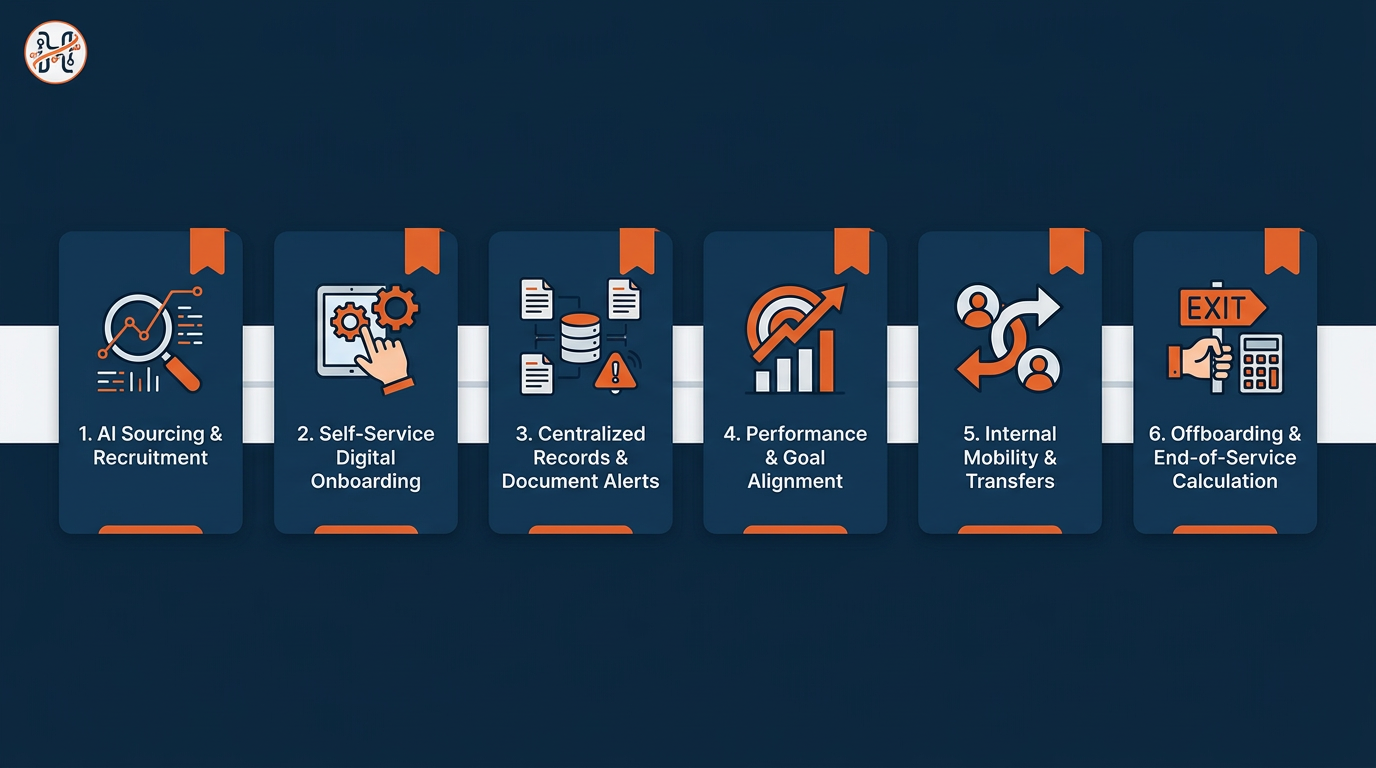
Employee lifecycle management is the structured framework through which an organization engages, guides, and manages a worker throughout their tenure. It spans six core phases:
- Attraction and Talent Acquisition
- Onboarding and Document Verification
- Core Workforce Administration and Document Tracking
- Performance Management and Professional Development
- Internal Mobility and Role Transfers
- Offboarding, Asset Recovery, and End-of-Service Processing
When these phases operate in isolation, HR teams experience systemic record mismatches, payroll disputes, and regulatory liabilities. Deploying an end-to-end system such as HR Suite by Smart Chain unifies these touchpoints under one database, providing leadership with real-time workforce visibility and operational consistency.
1. Talent Acquisition: Smarter Sourcing and Pipeline Acceleration
The employee journey begins well before day one. In high-growth companies, talent acquisition often breaks down under high applicant volume. Reviewing hundreds of resumes manually introduces bias, fatigue, and hiring delays.
AI-powered recruitment software streamlines this intake process through automated workflows:
- Automated Job Requisitions and Job Descriptions: HR managers can generate structured job descriptions and instantly publish openings across multiple channels.
- AI Resume Screening and Parsing: Machine intelligence evaluates incoming CVs against the concrete competencies outlined in the requisition, extracting technical qualifications, certifications, and relevant experience.
- Candidate Scoring and Shortlisting: Incoming profiles receive objective relevancy scores, allowing hiring managers to focus interview bandwidth exclusively on top-tier candidates.
- Structured Interview Management: Standardized interview scoring methodologies and automated communication ensure candidate interactions remain rigorous and uniform.
By systematizing recruitment, HR teams shorten time-to-hire while capturing baseline profile data that feeds directly into employee records upon selection.
2. Frictionless Onboarding: Day One Readiness Without the Paperwork
An employee's first impressions set the trajectory for their engagement and retention. Yet conventional onboarding often devolves into days spent filling out duplicate paper forms, submitting physical ID photocopies, and chasing signatures.
With centralized HR Suite features, onboarding transitions into an automated, self-service intake workflow:
- Digital Pre-boarding: Once an offer is accepted, the candidate receives access to their dedicated employee self-service portal before their start date. They submit their personal profiles, bank credentials, emergency contacts, and required tax identifiers directly.
- Document Ingestion: New hires securely upload national IDs, passports, educational certificates, and work visas.
- Automated Provisioning and Checklists: HR and operations teams assign system permissions, hardware assets, and compliance training modules via standardized digital task lists.
Automating administrative data capture eliminates redundant data entry, ensuring that payroll, attendance tracking, and compliance systems reflect accurate new-hire data on day one.
3. Centralized Records and Document Compliance
As organizations expand across multiple branches, entities, or jurisdictions, document governance becomes a critical vulnerability. Expired commercial visas, missing labor contracts, or out-of-date health certifications expose businesses to immediate regulatory penalties.
A central repository for employee records ensures governance through every stage of employment:
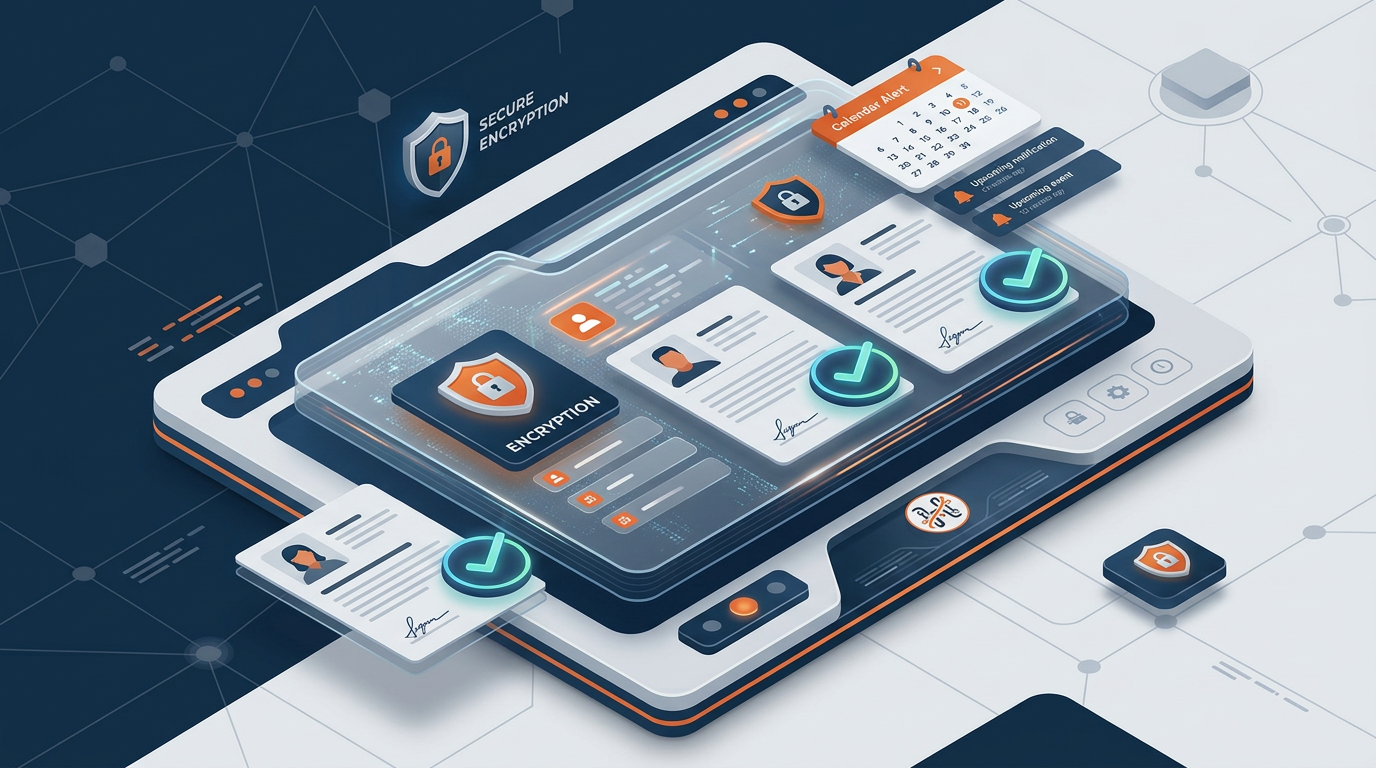
- Proactive Expiry Monitoring: Instead of auditing filing cabinets or static spreadsheets, modern systems monitor expiry dates for visas, passports, licenses, and insurance policies, automatically sending alert notifications to HR and employees well in advance.
- AI-Assisted Document Processing: Advanced scanning tools extract key metadata from uploaded files, cross-referencing identity details with local labor registries.
- Self-Service Verification: Through a mobile or web-based employee workspace, team members view their personal records, submit change requests, and download standardized HR letters (such as salary certificates or proof-of-employment) generated via automated templates.
According to research by the Society for Human Resource Management (SHRM), digitizing employee record workflows dramatically reduces human error while safeguarding regulatory readiness across complex labor environments.
4. Performance, Alignment, and Internal Mobility
Employee lifecycle management extends far beyond compliance checks; it directly dictates workforce productivity and retention. High-performing organizations monitor performance continuously rather than relying on an isolated, annual retrospective.
Integrated performance systems connect individual output to operational goals:
- Continuous Goal Tracking: Clear key performance indicators (KPIs) and objectives are documented within the employee’s active profile, visible to both the worker and their line manager.
- One-on-One Documentation: Scheduled review meetings and manager check-ins are logged inside the platform to document career progression and address operational blockers early.
- Internal Role Transfers and Entity Mobility: When an employee transfers between business units, shifts, or international subsidiaries (e.g., relocating within the UAE, Saudi Arabia, or broader international markets), the platform updates reporting lines, salary structures, and benefit entitlements without losing historical performance data.
Maintaining continuous records helps business leaders identify internal promotion candidates and resolve succession planning challenges before critical vacancies emerge.
5. Offboarding and End-of-Service (EOS) Governance
The offboarding phase carries substantial legal, security, and financial implications. A chaotic exit process creates risks such as unrevoked software access, unrecovered hardware assets, and calculation disputes regarding final salary settlements.
Comprehensive HR management software automates the offboarding protocol to ensure full risk mitigation:
Digital Exit Workflows and Asset Handover
When a resignation or termination notice is logged, the system initiates an automated exit sequence. IT, facilities, and department heads receive tasks to revoke platform access, retrieve physical equipment, and reassign current project ownership. Digital sign-offs guarantee that no settlement clears before all organizational assets are safely accounted for.
Compliant Final Settlements and End-of-Service Calculations
In many international jurisdictions—most notably across the GCC—calculating severance or End-of-Service (EOS) gratuity requires strict adherence to local labor codes. Manual calculations frequently cause disputes due to misinterpretations of:
- Basic salary versus comprehensive allowance allocations.
- Resignation versus termination criteria under limited or unlimited contracts.
- Unused annual leave day accruals.
- Prorated deductions for asset damages or outstanding company advances.
Modern workforce management platforms eliminate human calculation errors by running automated End-of-Service calculations configured to jurisdiction-specific labor standards. Final payslips, statutory deductions, and clearance certifications generate automatically, protecting the enterprise from labor disputes while ensuring fair, transparent exits.
Point Solutions vs. Unified Employee Lifecycle Management
Many organizations attempt to manage this journey using separate point software solutions for recruitment, attendance, payroll, and exit tracking. Here is how that approach compares to a unified architecture:
| Operational Capability | Fragmented Point Solutions | Unified Lifecycle Platform (HR Suite) |
|---|---|---|
| Data Integrity | High risk; manual sync required between ATS, payroll, and HR files. | Single source of truth across all modules from hire to exit. |
| Compliance & Expiry | Reactive; dependent on manual calendar checks and spreadsheets. | Automated system alerts for visas, certifications, and contract reviews. |
| Administrative Overhead | High; repeated data entry across multiple logins. | Minimal; automated pipelines and employee self-service tools. |
| Exit Settlements | Manual, formula-driven spreadsheet calculations prone to error. | Automated, jurisdiction-compliant End-of-Service calculations. |
| Workforce Visibility | Fragmented; requires manual data aggregation for reporting. | Real-time analytics, company health monitoring, and audit trails. |
The Strategic Advantage of Lifecycle Automation
Transitioning from administrative record-keeping to unified employee lifecycle management turns HR from a back-office cost center into an operational driver. When recruitment flows cleanly into onboarding, records remain synchronized with payroll, and exit protocols remain legally compliant, organizations save administrative hours, mitigate compliance fines, and provide a superior employee experience.
Whether running 50 employees in one location or coordinating thousands of workers across multiple regional subsidiaries, unifying the employee lifecycle provides the structural backbone necessary for sustainable scale.
Experience how an intelligent, end-to-end platform simplifies operations. Review our straightforward pricing options or test the platform directly with a 14-day free trial.
Frequently Asked Questions
What are the main stages of the employee lifecycle?
The complete employee lifecycle comprises talent acquisition (attraction and recruitment), onboarding, core employee administration and document management, performance management, internal transfers, and offboarding (including end-of-service settlement).
How does unified HR software improve regulatory compliance?
Unified platforms automate document expiration monitoring (e.g., visas, passports, national IDs), apply jurisdiction-specific employment policies, standardize contract templates, and compute accurate, compliant payroll and end-of-service gratuity calculations based on local labor laws.
Can HR software handle multi-country employee lifecycles?
Yes. Modern solutions like HR Suite feature multi-company and multi-country architectures, allowing organizations to run localized leave structures, working schedules, and payroll compliance rules across different international jurisdictions from a central administrative console.
How does AI enhance employee lifecycle management?
AI removes repetitive manual tasks across the journey by parsing and scoring candidate resumes against job criteria, generating standardized employment letters, extracting text from identity documents, and highlighting operational bottlenecks through predictive analytics.
Transform your workforce operations from hiring to exit. Start your 14-day free trial with HR Suite by Smart Chain and experience intelligent, end-to-end employee lifecycle management.
Frequently asked questions
What are the main stages of the employee lifecycle?
The complete employee lifecycle comprises talent acquisition (attraction and recruitment), onboarding, core employee administration and document management, performance management, internal transfers, and offboarding (including end-of-service settlement).
How does unified HR software improve regulatory compliance?
Unified platforms automate document expiration monitoring (e.g., visas, passports, national IDs), apply jurisdiction-specific employment policies, standardize contract templates, and compute accurate, compliant payroll and end-of-service gratuity calculations based on local labor laws.
Can HR software handle multi-country employee lifecycles?
Yes. Modern solutions like HR Suite feature multi-company and multi-country architectures, allowing organizations to run localized leave structures, working schedules, and payroll compliance rules across different international jurisdictions from a central administrative console.
How does AI enhance employee lifecycle management?
AI removes repetitive manual tasks across the journey by parsing and scoring candidate resumes against job criteria, generating standardized employment letters, extracting text from identity documents, and highlighting operational bottlenecks through predictive analytics.