The Future of Recruitment: AI Resume Screening and Candidate Scoring
Discover how AI recruitment software automates resume parsing, scores candidates objectively, and accelerates shortlisting for modern hiring teams.
The Future of Recruitment: AI Resume Screening and Candidate Scoring
Talent acquisition teams face an escalating volume challenge. A single corporate job opening can attract hundreds of applicants within 48 hours, leaving recruiters to spend an average of several hours each day manually sifting through resumes. This manual bottleneck slows time-to-hire, introduces fatigue-driven human bias, and lets top-tier candidates slip through to competitors.
Modern talent acquisition demands an operational shift from manual administrative sorting to data-driven talent intelligence. High-performing organizations are adopting AI recruitment software to automate resume ingestion, parse unstructured candidate histories, and rank applicants against objective scoring rubrics.
By leveraging intelligent talent workflows—such as those delivered by HR Suite by Smart Chain—enterprises can transform their hiring pipeline from an unorganized queue of documents into an automated, transparent, and objective evaluation engine.
How Modern AI Recruitment Software Transforms Candidate Discovery
Traditional recruitment tracking systems (ATS) rely heavily on blunt-force keyword filters. If a candidate lists "people operations" instead of "HR management," a legacy filter often discards their CV. This crude matching mechanism penalizes qualified talent while rewarding candidates who aggressively game keyword systems.
Modern AI recruitment software replaces static Boolean searches with natural language processing (NLP) and contextual data extraction. Instead of matching exact character strings, AI algorithms analyze semantics, career trajectories, and project scopes.
Contextual Resume Parsing
Resume parsing converts unstructured PDFs, Word documents, and portfolio links into structured candidate profiles. Intelligent parsing extracts:
- Core Competencies and Hard Skills: Differentiating between foundational familiarity and senior-level application.
- Tenure and Career Progression: Tracking promotions, role continuity, and organizational context.
- Certifications and Regulatory Compliance: Verifying regional credentials, professional licenses, and educational degrees.
- Geographic and Mobility Factors: Evaluating residency status, work authorization parameters, or relocation readiness.
By normalizing disparate CV layouts into standardized candidate attributes, recruitment teams gain a level playing field for every applicant before the initial human review begins.
Objective Candidate Scoring Matrices: Beyond Keyword Matching
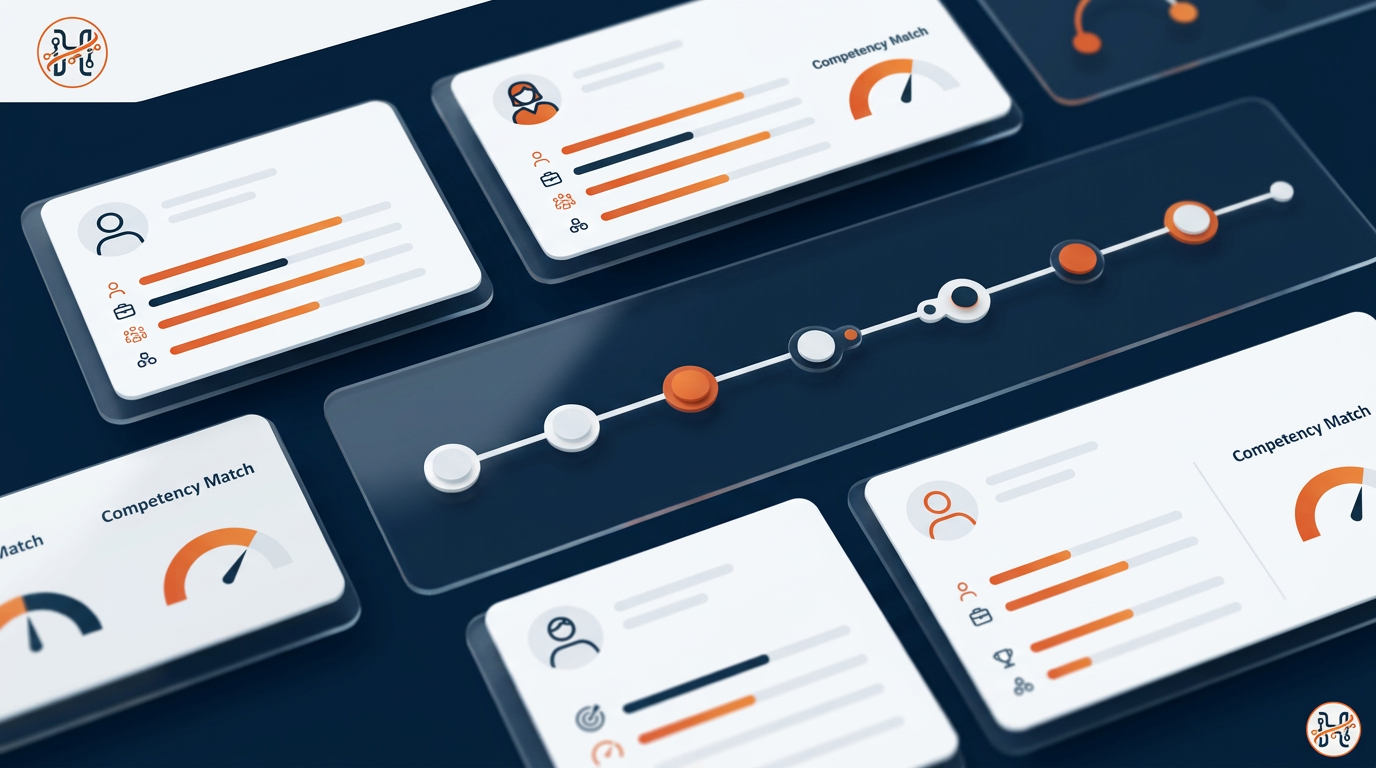
Once resumes are parsed into structured data points, advanced recruitment engines apply an objective candidate scoring matrix. Rather than relying on gut feeling or subjective first impressions, the software evaluates applicants against predefined hiring criteria established during role configuration.
Anatomy of an AI Scoring Matrix
An operational candidate scoring engine evaluates an applicant across multiple weighted categories:
- Functional Skills Match (30–40%): Direct alignment between the candidate's verified skill set and the technical requisites of the position.
- Industry and Domain Experience (20–30%): Practical exposure within comparable market sectors or operational environments.
- Scope and Responsibility Index (15–20%): Evidence of leadership, budgetary oversight, or team management commensurate with the seniority level.
- Logistical and Regional Fit (10–15%): Language proficiencies, local labor compliance eligibility, or availability for immediate onboarding.
Traditional Screening vs. AI-Assisted Candidate Scoring
| Evaluation Metric | Traditional Manual Screening | Legacy ATS Keyword Filter | Modern AI Recruitment Software |
|---|---|---|---|
| Evaluation Speed | 3–5 minutes per resume | < 1 second per resume | < 2 seconds per resume |
| Contextual Accuracy | High, but prone to fatigue | Low; misses semantic synonyms | High; evaluates contextual relevance |
| Scoring Consistency | Subjective and variable | Binary (pass/fail) | Calibrated, percentage-based ranking |
| Candidate Transparency | No audit trail | Hidden rejection triggers | Explainable scoring rubrics |
| Data Integration | Manual spreadsheet data entry | Basic candidate profile upload | Instant sync with core HR features |
By generating a transparent composite score (e.g., 88/100), the system surfaces the most qualified profiles to the top of the recruiter's pipeline, complete with a contextual summary explaining why the score was assigned.
From Application to Shortlist: The Automated Screening Pipeline
Automating the top of the funnel allows talent teams to redeploy their working hours into proactive candidate engagement. A fully automated screening and shortlisting pipeline operates in continuous, structured phases:
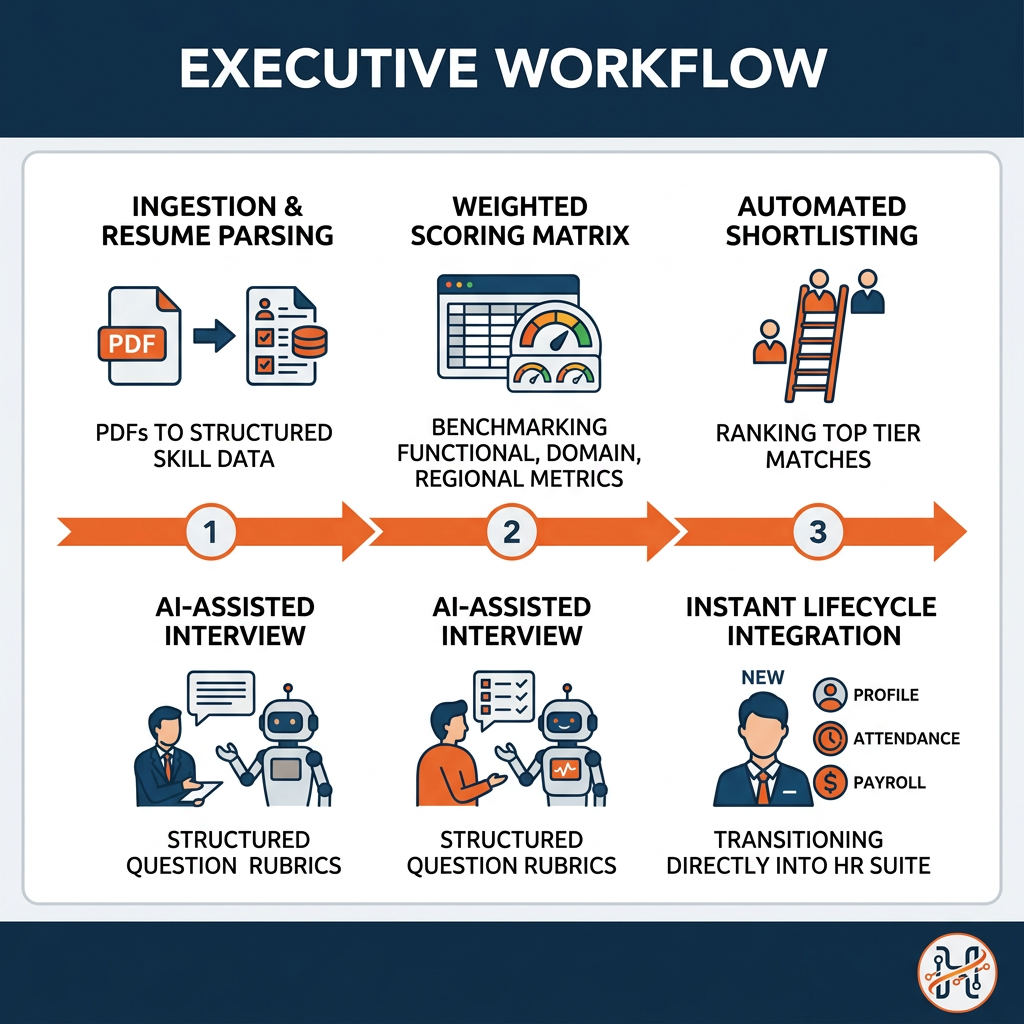
Job Requisition Created → Influx of Applications → Contextual Resume Parsing → Weighted Matrix Scoring → Automated Shortlisting → AI Interview Prep → Final Hire
1. Requisition Calibration
Hiring managers input explicit competencies, minimum benchmarks, and desirable secondary qualifications into the recruitment workspace.
2. Autonomous Ingestion and Ranking
As candidates apply, the engine parses incoming data instantaneously. Candidates meeting or exceeding threshold scores move automatically into the initial shortlist pool, while applicants lacking mandatory certifications or prerequisites receive polite, automated status notifications.
3. Dynamic Pipeline Visibility
Recruiters open their dashboard to view a dynamic leaderboard of candidates ranked by relevance. Instead of reading through 400 applications, hiring managers can focus directly on the top 15 deeply qualified profiles.
AI-Assisted Interviews: Structured Questioning and Objective Evaluation
Effective recruitment does not end with resume screening; interviewing remains the most critical—and vulnerable—phase of the evaluation lifecycle. Traditional interviews frequently suffer from inconsistent questioning across candidates, making objective cross-comparison impossible.
AI recruitment workflows now extend into the interview room to support hiring managers:
- Role-Specific Question Generation: Based on the gaps, ambiguities, or strengths flagged during resume screening, the system produces targeted behavioral and situational interview questions.
- Competency Rubrics: Interviewers receive standardized evaluation scorecards directly inside their workspace, ensuring that every panelist grades responses against uniform benchmarks.
- Cross-Interviewer Calibration: The platform aggregates individual scorecards, highlighting alignment or divergence among interview panel members to foster evidence-based hiring decisions.
This structured methodology ensures that organizational hiring standards remain uniform across different business units, departments, and international operating subsidiaries.
Mitigating Bias and Protecting Compliance in Automated Hiring
When organizations automate recruitment, compliance and fairness are essential. Biased or opaque algorithms present operational and legal risks. Reputable talent platforms adhere to a strict human-in-the-loop architecture.
Explainable AI and Blind Review
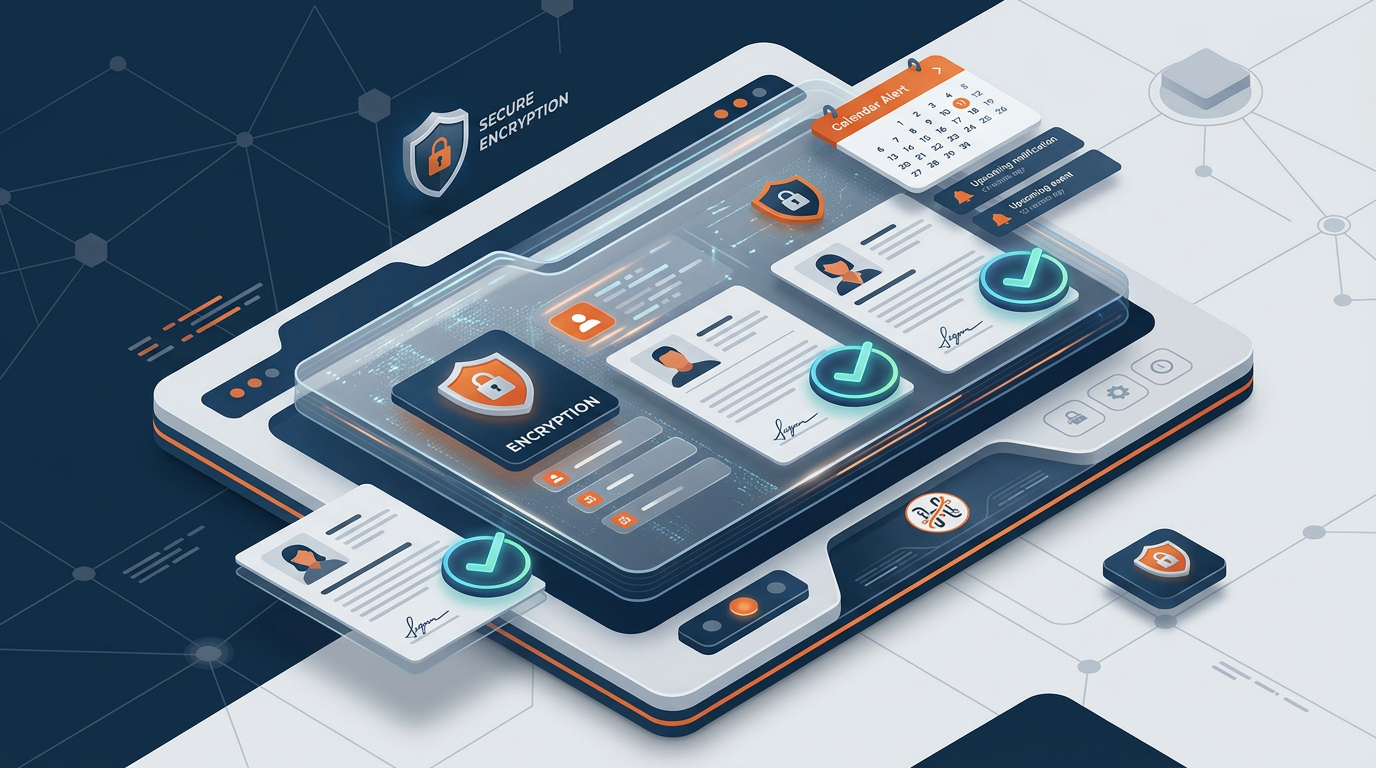
Advanced scoring engines focus exclusively on skills, achievements, and competencies. Modern systems can redact personally identifiable information (PII)—such as name, gender, age, and home address—during initial screening phases to eliminate unconscious bias. Furthermore, scoring explanations show exactly which qualifications drove a candidate's rank, maintaining an audit-ready evaluation record.
Authoritative research from organizations like the Society for Human Resource Management (SHRM) consistently demonstrates that structured, skill-first screening improves long-term retention and organizational performance compared to unstructured pedigree filtering.
Unifying Recruitment with the Broader Employee Lifecycle
Standalone recruitment tools create isolated data silos. When an applicant is hired, their records, credentials, and identity documents often have to be manually re-entered into separate systems for payroll, attendance, and record-keeping.
HR Suite solves this fragmentation by embedding AI-powered recruitment directly into an enterprise workforce management platform.
Recruitment Pipeline → AI Candidate Scoring → Offer Acceptance → One-Click Profile Creation → Self-Service Workspace & Payroll Onboarding
With HR Suite, transitioning from applicant to team member is frictionless:
- Instant Profile Conversion: A hired candidate's parsed resume data, verified credentials, and contact details instantly populate their core employee file.
- Immediate Compliance Setup: Regional document tracking—such as visas, IDs, and statutory contracts across regions like the UAE, Saudi Arabia, Egypt, the UK, or India—is initiated automatically.
- Integrated Workforce Operations: New hires are immediately mapped to designated shifts, attendance management workflows, leave policies, and payroll calculation groups without double data entry.
Conclusion: Building an Intelligent Talent Acquisition Strategy
Recruitment is no longer about managing administrative paperwork; it is a competitive lever for business growth. Relying on manual resume reviews and keyword-stuffed searches delays critical hires and burdens talent acquisition teams with repetitive administrative tasks.
Deploying intelligent AI recruitment software allows growing businesses to parse applications instantly, evaluate candidates against objective, weighted scoring matrices, and conduct calibrated interviews with complete transparency. By uniting recruitment with core workforce management, modern organizations hire faster, reduce bias, and set up new employees for long-term productivity from day one.
Ready to streamline your hiring pipeline? Discover how HR Suite centralizes hiring, attendance, and payroll operations. Start your 14-day free trial or explore our transparent pricing plans today.
Transform your talent acquisition workflows and eliminate administrative recruitment bottlenecks. Experience HR Suite by Smart Chain risk-free—start your 14-day free trial today.
Frequently asked questions
What is AI recruitment software and how does it screen candidates?
AI recruitment software uses natural language processing (NLP) and contextual analysis to read incoming CVs, extract relevant skills, qualifications, and employment history, and score candidates against a predefined job specification matrix rather than relying on basic keyword searches.
Does AI candidate scoring eliminate the role of human recruiters?
No. Modern AI recruitment engines operate on a human-in-the-loop model. The AI handles repetitive tasks such as parsing, organizing, and preliminary scoring, while recruiters and hiring managers make all final interview, shortlisting, and hiring decisions.
How does an AI scoring matrix handle candidates with non-traditional career paths?
Unlike traditional ATS filters that reject non-standard resumes, semantic AI engines identify transferable competencies, project achievements, and skill equivalencies across industries, enabling fair evaluation based on actual capability.
Can HR Suite's AI recruitment engine connect directly to onboarding and payroll?
Yes. In HR Suite, when a candidate is hired, their parsed records and documents instantly transition into the core employee database, allowing seamless setup for attendance tracking, self-service access, and localized payroll.