How Automated Payroll Software Simplifies Salary Processing
Discover how automated payroll software streamlines salary components, deductions, payslips, approvals, and compliance for modern organizations.

How Automated Payroll Software Simplifies Salary Processing
For growing organizations, salary processing remains one of the most critical yet operationally vulnerable HR responsibilities. When handled through fragmented spreadsheets and manual cross-checks, calculating monthly compensation frequently results in calculation errors, delayed bank transfers, compliance oversights, and strained employee trust. A single misplaced formula or overlooked absence record can ripple across entire departments.
Adopting automated payroll software transforms this high-stakes administrative burden into a structured, reliable, and repeatable operation. By unifying core timekeeping, leave records, salary rules, and approval hierarchies within an integrated HR management platform, organizations eliminate manual intervention while safeguarding data accuracy.
Here is an operational guide to how modern payroll engines simplify salary processing—from defining complex salary structures to distributing payslips and generating executive audit reports.
1. Structuring Dynamic Salary Components and Allowances
Employee compensation rarely consists of a uniform lump sum. Modern compensation packages are multi-layered structures tailored by seniority, role, entity, and geography. Calculating these elements manually requires constant verification against employment contracts.
Modern payroll systems standardize and automate this architecture through configurable earning rules:
- Base Salary Calculations: Establishing predictable baseline wages linked directly to contracts and active employment statuses.
- Fixed Allowances: Automatically allocating standard monthly benefits such as housing allowances, transport stipends, cost-of-living adjustments (COLA), and utility allowances.
- Variable Pay & Incentives: Integrating sales commissions, production bonuses, shift differentials, and overtime hours pulled directly from verified attendance logs.
- Prorated Earnings: Dynamically adjusting payouts for mid-month joiners or departures based on exact calendar days worked without requiring manual spreadsheet formulas.
By centralizing salary structures, HR Suite by Smart Chain ensures that each worker's gross earnings calculate automatically according to their assigned grade and company compensation policy.
2. Managing Deductions, Loans, and Absence Adjustments
Gross pay is only the first step of payroll processing. Deductions represent the most common point of operational failure in manual payroll workflows. Between statutory requirements, company loans, and unpaid time off, human payroll managers often spend days reconciling disparate records.
Automated systems resolve this friction by directly bridging time-and-attendance data with payroll engines:
Time and Attendance Integration
When attendance systems operate in isolation from payroll, deductions for late check-ins, early departures, and unapproved leaves require manual reconciliation. An integrated platform automatically computes unpaid leave deductions by comparing real-time punch logs (via facial recognition, QR code, or GPS geofencing) with approved leave records.
Recurring and Non-Recurring Deductions
Automated platforms handle complex deduction categories seamlessly:
- Statutory Deductions: Accurately calculating national social insurance contributions, pension obligations, and municipal withholdings according to local entity guidelines.
- Company Advances and Asset Deductions: Tracking employee loan repayments, equipment purchase deductions, or disciplinary penalties over predefined amortization schedules.
- Voluntary Deductions: Managing recurring benefits contributions, private health coverage upgrades, or employee savings schemes.
When these calculations are automated, HR teams prevent overpayments and avoid tedious retroactive corrections in subsequent pay runs.
3. End-to-End Payroll Processing and Multi-Tier Approval Workflows
Transparency and internal governance are essential to payroll risk management. Unrestricted administrative access or single-point processing models increase the risk of payroll fraud, unauthorized compensation revisions, and unchecked calculation errors.
Automated payroll software replaces informal sign-offs with strict, auditable maker-checker authorization protocols.
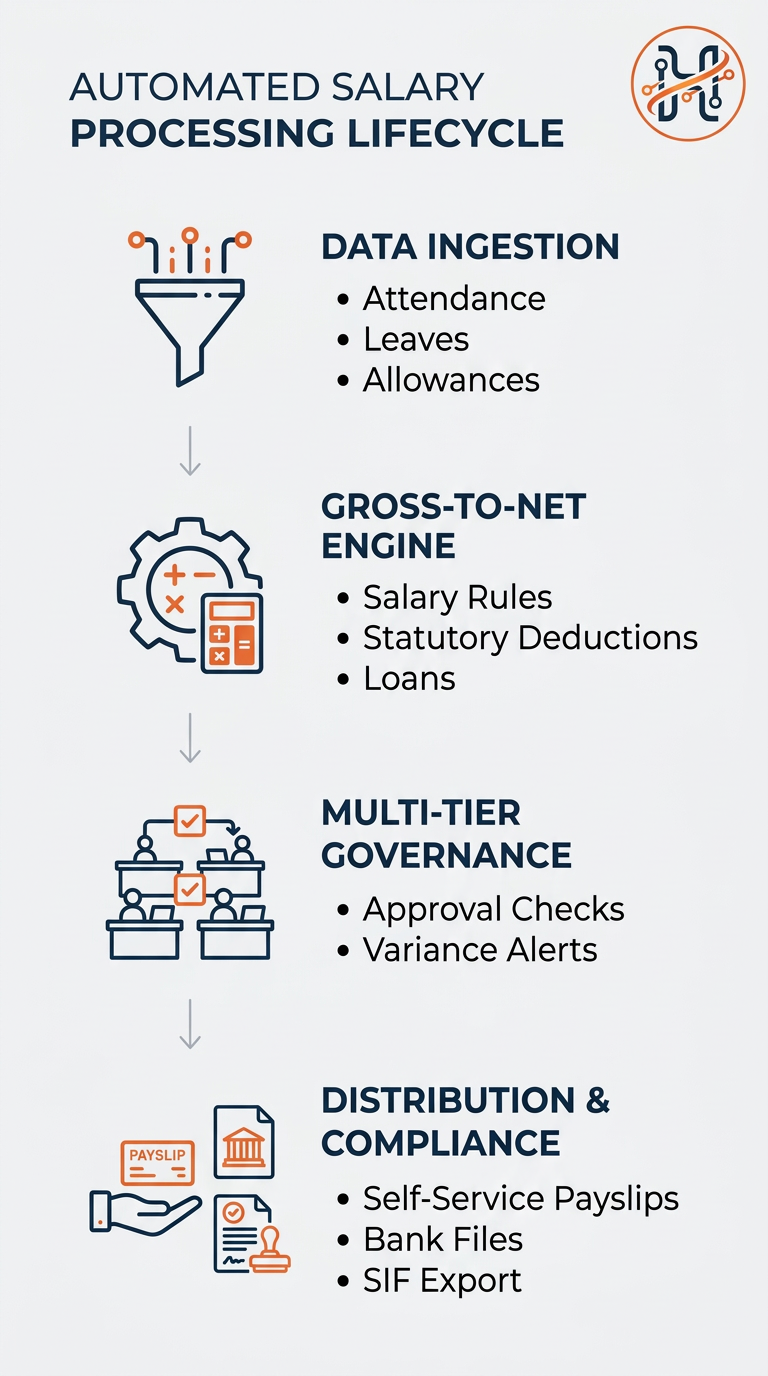
Standard Automated Flow: Data Ingestion (Attendance & Leave) → Automated Run (Gross-to-Net Engine) → Multi-Tier Approvals (HR, Finance, CFO) → Disbursement & Reporting (Bank Files, SIF, Payslips)
- Automated Pay Run Initialization: The system compiles approved attendance records, overtime hours, active salary structures, and variable allowances into a preliminary draft pay run.
- Anomaly Detection: Embedded verification rules flag statistical anomalies—such as sharp overtime spikes, unexpected salary variances above a preset threshold, or duplicate bank entries.
- Role-Based Approval Routing: The preliminary batch moves through customized approval gates (e.g., Payroll Officer → People Ops Director → Chief Financial Officer). Each stakeholder inspects side-by-side variance reports before granting approval.
- Batch Locking: Once authorized, the pay run is cryptographically locked, preventing post-approval modifications and preserving a permanent audit trail.
4. Manual Payroll vs. Automated Payroll Software
Comparing traditional spreadsheet-driven processes with purpose-built automation highlights significant operational improvements:
- Data Consolidation: Spreadsheets rely on disconnected files and email threads; automated platforms utilize a centralized database synced with live attendance and leave modules.
- Calculation Accuracy: Manual workflows are prone to broken formulas and omission errors; automated software employs a deterministic gross-to-net engine yielding zero calculation errors.
- Policy Enforcement: Manual systems rely on individual memory; automated systems apply consistent internal policies and localized country rules programmatically.
- Approval Governance: Spreadsheets rely on untracked emails; automated systems generate timestamped multi-level audit trails.
- Payslip Distribution: Manual methods require emailing individual PDFs; automated platforms provide instant, encrypted downloads via an employee self-service portal.
5. Instant Payslip Distribution and Employee Self-Service
The payroll cycle does not end when funds leave the corporate bank account. In traditional workflows, HR teams spend subsequent business days answering queries, generating tax summaries, and manually emailing password-protected PDFs.
Modern payroll management software eliminates these repetitive requests through comprehensive employee self-service workspaces:
- Automated Payslip Generation: Detailed digital payslips generate the moment a pay run finalizes, outlining basic earnings, itemized allowances, tax withholdings, and overtime balances.
- Anytime Mobile Access: Employees securely access historical and current earnings statements directly via their mobile or desktop portals, reducing repetitive inquiries to the HR helpdesk.
- Transparent Year-to-Date (YTD) Overviews: Workers track cumulative compensation, bonus history, and deductions independently, building organizational trust and transparency.
By empowering employees with on-demand access to their compensation records, HR departments protect their time to focus on strategic organizational initiatives.
6. Comprehensive Payroll Reporting and Multi-Country Compliance
Operating across international boundaries or distinct legal entities introduces distinct compliance obligations. From local wage protection mandates like the UAE Wages Protection System (WPS) monitored by the Ministry of Human Resources and Emiratisation (MOHRE) to end-of-service gratuity reconciliations across the GCC, organizations require specialized compliance reporting.
An advanced platform provides granular financial intelligence alongside localized compliance exports:
- Standardized Banking Exports: One-click generation of bank payment files and Wage Protection System Salary Information Files (WPS SIF) formatted precisely for direct central bank processing.
- End-of-Service (EOS) Accruals: Continuous tracking of severance and gratuity liabilities according to local employment contracts and regional labor mandates, ensuring balance sheets remain accurate.
- General Ledger (GL) Variance Reports: Comprehensive departmental, cost-center, and company-wide compensation summaries designed for straightforward reconciliation by finance and accounting teams.
- Custom Financial Analytics: Longitudinal reporting that highlights overtime expenditure trends, cost-per-department trajectories, and workforce headcount costs.
Organizations scaling across regions benefit from platforms configured with localized compliance packs (covering jurisdictions like the UAE, KSA, Egypt, India, the UK, and beyond), ensuring legal obligations are met without custom programming.
Modernize Your Payroll Operations with HR Suite
Executing payroll should be a friction-free operational checkpoint, not an exhausting monthly challenge. Transitioning from fragmented tools to a centralized, automated payroll software framework protects your business from administrative errors, elevates financial governance, and fosters confidence across your workforce.
HR Suite by Smart Chain unifies multi-country payroll processing, smart time-and-attendance tracking, recruitment, and self-service administration into a single AI-powered HR platform. Whether running operations for 25 employees or scaling across multiple international entities, HR Suite provides the automation and precision modern enterprises demand.
Are you ready to eliminate spreadsheet errors and reclaim your time? Contact our team to review your payroll architecture, or start your 14-day free trial to experience automated salary processing firsthand.
Streamline your salary processing and secure full compliance across your workforce. Start your 14-day free trial of HR Suite by Smart Chain today.
Frequently asked questions
How does automated payroll software connect with daily employee attendance?
Automated payroll software integrates directly with time-tracking hardware and mobile attendance systems (such as facial recognition, QR codes, and GPS geofencing). Unapproved absences, unpaid leaves, and verified overtime hours flow straight into the payroll calculation engine, automatically factoring into gross-to-net salary calculations without manual data entry.
Can automated payroll platforms support multi-country salary processing?
Yes. Platforms equipped with multi-country architecture allow organizations to run payroll for different legal entities across multiple regions. They apply jurisdiction-specific tax rules, social contributions, statutory deductions, and specialized file formats—such as UAE WPS SIF files—within a single, unified HR system.
How are variable allowances and employee commissions managed in payroll software?
Variable components such as sales commissions, travel stipends, or performance bonuses can either be imported in bulk or configured with dynamic business rules. The software calculates gross pay according to assigned salary structures while maintaining complete visibility over variable compensation.
What measures prevent errors during the payroll approval process?
Automated payroll software enforces maker-checker governance workflows. Preliminary pay runs undergo automated anomaly checks (highlighting sudden spikes or mismatches), followed by multi-tiered approval chains involving HR leads, Finance Directors, and C-suite stakeholders before disbursements are finalized and locked.