HR Software for Multi-Country Businesses: Managing Employees Across Different Jurisdictions
Discover how multi-country HR software streamlines cross-border payroll, regional compliance, public holidays, and multi-entity operations from one hub.

HR Software for Multi-Country Businesses: Managing Employees Across Different Jurisdictions
Expanding operations across international borders is a significant milestone for any growing organization. However, managing human resources across multiple legal jurisdictions introduces operational friction. HR directors, operations managers, and CFOs often find themselves caught between disparate local employment regulations, fragmented payroll schedules, diverse statutory deductions, and distinct cultural calendars.
Without an integrated operational framework, organizations frequently resort to running separate, disconnected platforms in every country. This patchwork approach leads to data silos, administrative bloat, delayed reporting, and elevated compliance exposure.
To overcome these hurdles, forward-thinking enterprises rely on modern multi-country HR software. By centralizing employee lifecycles, statutory compliance, localized attendance, and payroll architectures into a unified platform, international operations become scalable, compliant, and transparent.
Here is an operational guide to evaluating and managing cross-border teams using dedicated workforce technology, including the role played by HR Suite by Smart Chain.
The Core Challenges of Cross-Border People Operations
When a business scales from one operating market to three, five, or ten, HR administration does not merely scale linearly—it compounds in complexity.
1. Divergent Labor Laws and Statutory Rules
Employment contracts, statutory probation periods, maximum overtime thresholds, and termination protocols vary drastically from country to country. For example, managing an employee in the United Kingdom requires compliance with statutory sick pay and HMRC reporting, while employing workers in the UAE mandates strict adherence to the UAE Labor Law, Wage Protection System (WPS) filings, and specific End-of-Service (EOS) gratuity calculations.
2. Disjointed Payroll and Currency Structures
Running multi-country operations often forces finance teams to juggle distinct currencies, localized bank transfer formats, and varying taxation frameworks. Reconciling payroll across multiple countries using spreadsheets invites human error, creates discrepancies in general ledgers, and delays monthly closes.
3. Asymmetric Workweeks and Public Holidays
Operating globally disrupts traditional scheduling. While Western economies observe a Monday-to-Friday workweek, several Middle Eastern markets configure their working schedules differently. Furthermore, national and religious holidays—such as Eid, Diwali, or bank holidays—rarely align. Coordinating multi-region collaboration without an automated calendar system results in project bottlenecks and attendance discrepancies.
4. Fragmented Employee Records and Security Risks
Storing employee records across regional file drives, local SaaS point solutions, and local spreadsheets poses serious data protection challenges under regulations like GDPR. Centralized visibility into headcount, turnover trends, and performance metrics becomes practically impossible.
Key Architectural Features of Multi-Country HR Software
Selecting the right multi-country HR software requires evaluating whether the platform provides localized execution alongside centralized visibility. The following architectural components are critical.
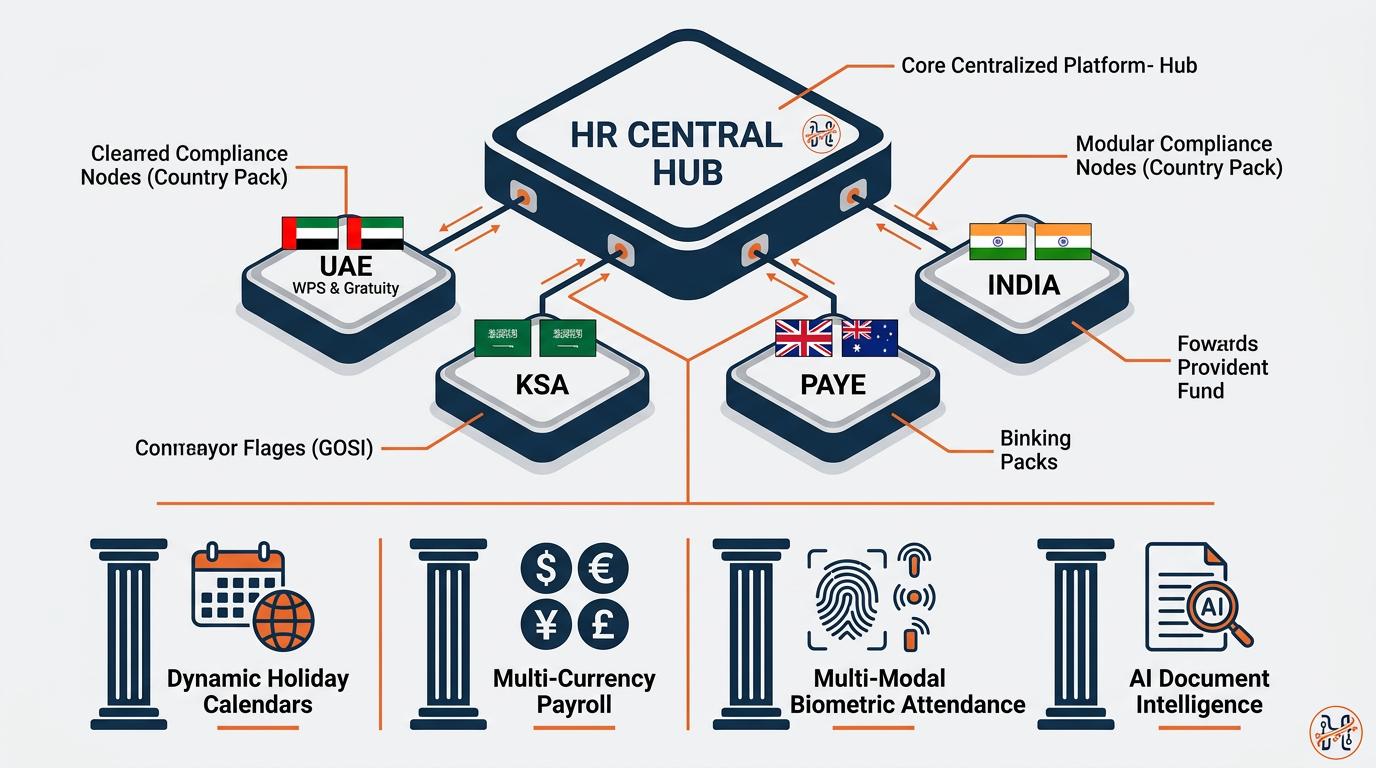
Pre-Configured Country Packs
A true multi-jurisdiction HR platform provides modular "country packs." These packs automatically apply local statutory calculations, leave entitlements, social insurance rules, and mandatory documents based on the employee's legal hiring entity.
Key regional configurations include:
- United Arab Emirates (UAE): Automated generation of WPS SIF (Salary Information File) formats, accurate calculation of gratuity under Federal Decree-Law No. 33 of 2021, and tracking of residency visas and labor cards.
- Kingdom of Saudi Arabia (KSA): Alignment with Saudi Labor Law, General Organization for Social Insurance (GOSI) parameters, and Qiwa-aligned contract workflows.
- Egypt, India, and Pakistan: Integrated allowances, localized tax brackets, provident funds, and statutory social security frameworks.
- United Kingdom & United States: Dynamic support for regional tax codes, state/federal requirements, and standard local benefits.
Multi-Entity and Multi-Company Management
Parent companies often hold subsidiaries, branch offices, or free-zone entities. Effective HR management software must provide multi-company structures within one tenant. This enables HR leaders to switch between corporate entities, apply distinct branding or organizational charts, and generate entity-level audits—while the executive team views consolidated company health metrics.
Dynamic Leave and Working Calendar Engines
A cross-border HRMS must support multi-tier calendar engines that assign public holidays and working patterns based on the employee’s assigned office or country profile. An employee in Cairo automatically inherits Egyptian national holidays, while an employee in London follows UK bank holidays, preventing cross-jurisdictional scheduling confusion.
Universal Attendance Tracking
Managing field staff, distributed engineers, and office workers across time zones requires flexible timekeeping. Modern platforms combine web attendance, QR codes, GPS geofencing with anti-spoofing algorithms, and facial recognition biometric hardware into a unified attendance management system. Attendance data feeds directly into payroll rules across every operating country.
Comparison: Fragmented Point Solutions vs. Unified Multi-Country HRMS
To understand the strategic advantage of an all-in-one platform like HR Suite, compare the standard decentralized model with an integrated architecture:
- Data Storage: Decentralized models disperse data across regional spreadsheets; a unified platform provides a centralized, secure master database.
- Payroll Preparation: Decentralized operations require manual data extraction; a multi-country HRMS generates automated, localized payroll and WPS SIF files.
- Statutory End of Service: Manual spreadsheet formulas risk calculation errors; dedicated engines compute compliant, audit-ready EOS gratuities automatically.
- Time & Attendance: Disconnected biometric hardware creates information silos; unified platforms support GPS, QR, web, and biometric tracking in real time.
- Employee Experience: Fragmented tools mean disparate logins; unified platforms provide an all-in-one self-service workspace.
- Executive Visibility: Compiling cross-border reports takes weeks; modern platforms deliver real-time color-coded Company Health Monitoring (Green/Yellow/Red).
Deep-Dive: Navigating Complex GCC and International Compliance
Compliance is where cross-border workforce administration faces its strictest tests. Organizations operating across the Gulf Cooperation Council (GCC) face specific statutory mechanisms that global HR solutions designed purely for Western markets often fail to address.
1. Wage Protection Systems (WPS)
In jurisdictions like the UAE and Saudi Arabia, salary disbursement is regulated via electronic wage transfer monitoring. In the UAE, private sector employers registered with the Ministry of Human Resources and Emiratisation (MOHRE) must disburse payments via authorized banks and exchange houses using precisely formatted Salary Information Files (SIF). HR Suite provides direct SIF generation, ensuring banking routing codes, employee labor identifiers, and basic-versus-allowance breakdowns conform to MOHRE standards.
According to the International Labour Organization (ILO), transparent wage protection mechanisms significantly mitigate industrial disputes and guarantee institutional accountability across international labor corridors.
2. End-of-Service (EOS) Gratuity Automation
Unlike standard Western severance models, GCC jurisdictions mandate statutory gratuity accruals upon contract conclusion. Calculating these liabilities requires dynamic variables including contract type, length of service, basic salary exclusions, and termination vs. resignation criteria. Automating these accruals inside your workforce software guarantees balance-sheet accuracy during external audits.
3. Expiry and Document Tracking for Expatriate Workforces
Multi-country operations employ high percentages of expatriate workers. Expired commercial trade licenses, corporate establishment cards, employment visas, or national IDs bring legal penalties and block ministry portals. Automated alerts notify HR administrators 90, 60, and 30 days prior to document expiration, transitioning compliance from reactive scrambling to scheduled maintenance.
The Role of AI in Streamlining Multi-Jurisdiction People Operations
Operating across boundaries increases paperwork. Applying artificial intelligence as a practical productivity layer eliminates administrative overhead.
AI-Powered Document Analysis and Letter Drafting
Generating employment verification letters, bank letters, or visa request documents in various formats consumed hours of operational time in the past. With embedded AI, HR Suite allows teams to generate tailored, legally structured HR letters and notices instantaneously, adapting terminology to match local jurisdiction conventions.
Cross-Border AI Recruitment
Finding talent across multiple countries requires evaluating diverse resume formats and academic accreditations. HR Suite's AI recruitment engine automates resume parsing, candidate scoring, and shortlisting based on job descriptions. This allows talent acquisition teams to run localized candidate pipelines—from job posting to interview scheduling—within a single workspace.
How to Transition to a Unified Cross-Border HR Platform
Migrating regional teams to a centralized solution requires a methodical rollout:
- Standardize Master Data Fields: Define global fields while preserving mandatory country-specific fields (such as UAE Emirates ID, Saudi Iqama, or Indian PAN).
- Configure Country Packs Sequentially: Set up your primary headquarters entity first, validate local holiday calendars and payroll profiles, and then expand to international subsidiaries.
- Roll Out Employee Self-Service (ESS): Provide staff with access to check leave balances, submit expense requests, and view payslips independently.
- Connect Timekeeping Methods: Equip physical branches with QR or facial recognition kiosks, while granting field personnel access via GPS-verified mobile attendance.
Conclusion: Build an Agile Global Workforce with HR Suite
Operating across borders should be a commercial advantage, not an operational bottleneck. Attempting to manage multiple legal entities, fluctuating currencies, complex statutory gratuities, and disparate holiday structures using legacy spreadsheets or disconnected regional tools slows growth and invites costly compliance risks.
Deploying dedicated multi-country HR software like HR Suite by Smart Chain unifies your distributed workforce under a single pane of glass. Combining embedded regional compliance packs (UAE, KSA, Egypt, India, UK, US, Pakistan), automated payroll exports, flexible attendance tracking, and practical AI tools, HR Suite enables your team to operate efficiently anywhere in the world.
Unify your international people operations today. Start your 14-day free trial or speak with our solutions team to explore custom multi-entity configurations.
Ready to streamline cross-border HR and payroll? Experience HR Suite by Smart Chain with a 14-day free trial and manage all your regional entities from a single intelligent platform.
Frequently asked questions
What is multi-country HR software?
Multi-country HR software is a unified workforce management platform engineered to support multiple legal entities, currencies, localized labor regulations, statutory payroll filings (such as UAE WPS), and distinct public holiday calendars across several jurisdictions within one centralized system.
How does HR Suite handle payroll compliance in the UAE and Saudi Arabia?
HR Suite includes dedicated country packs with built-in statutory logic. For the UAE, it automatically generates compliant WPS SIF files for banking distribution and calculates End-of-Service (EOS) gratuity under UAE Labor Law. For Saudi Arabia, it accommodates GOSI calculations and local regulatory employment frameworks.
Can different entities have separate leave policies and working schedules?
Yes. HR Suite allows multi-company organizations to assign unique working calendars, weekend patterns, and statutory holiday allowances to each subsidiary or country office, ensuring automated schedule alignment across diverse teams.
How does multi-country HR software maintain employee data privacy?
Platforms like HR Suite provide role-based access control (RBAC), multi-entity data partitioning, and centralized digital repositories. This ensures regional managers access only their assigned entities, while corporate leadership retains governed visibility without risking data compliance breaches.