Multi-Country HR Software: Managing a Global Workforce from One Platform
Scale global operations seamlessly. Discover how multi-country HR software manages entities, localized payroll, holidays, and compliance from one system.

Multi-Country HR Software: Managing a Global Workforce from One Platform
Expanding across borders is an operational milestone, but for People Operations and finance leaders, it often triggers administrative fragmentation. As organizations establish entities in new jurisdictions, they quickly discover that single-country HR systems cannot handle differing employment laws, tax structures, banking requirements, and localized benefit schemes.
Without a unified platform, companies end up stitching together regional spreadsheets, localized payroll bureaus, and isolated point solutions. This disjointed approach creates blind spots for executive leadership, increases compliance risk, and frustrates cross-border employees.
To scale efficiently, organizations need modern multi-country HR software that standardizes core people workflows while respecting local labor laws. HR Suite by Smart Chain provides this exact foundation—delivering an AI-native workforce management platform built to orchestrate complex, multi-entity operations from a single dashboard.
The Architecture of Multi-Country HR Software: Centralized Control, Local Execution
Traditional HR platforms are built on a single-entity architecture: one database, one currency, one calendar, and one set of labor rules. When an organization acquires a subsidiary or opens an office in Dubai, Riyadh, London, or Mumbai, the single-entity system fails.
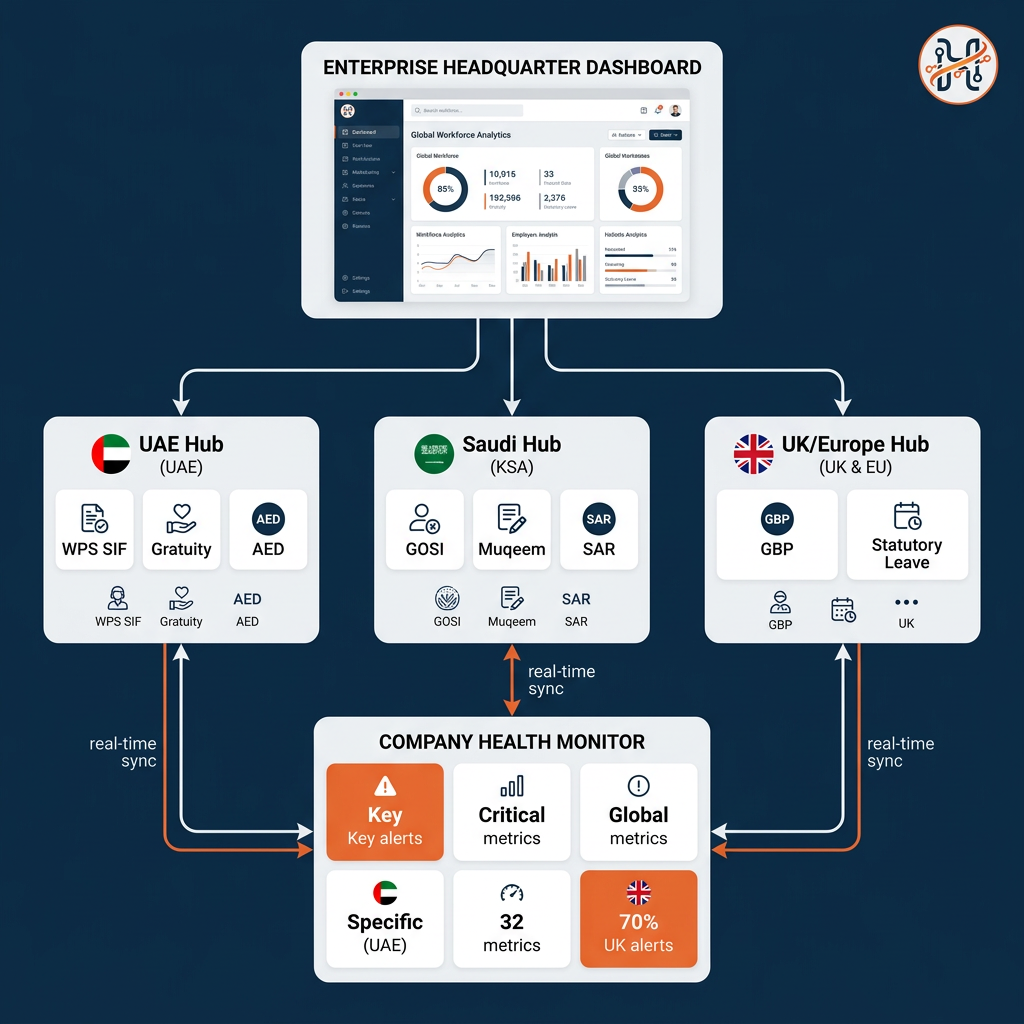
True multi-country HR software operates on a multi-company, multi-tenant architecture designed around three core architectural layers:
- The Global Governance Layer: Allows headquarters to define company-wide organizational hierarchies, reporting lines, executive analytics, and enterprise access permissions.
- The Legal Entity Layer: Isolates corporate entities for accounting, statutory filing, and legal auditing purposes, ensuring data separation where required by privacy regulations.
- The Localization Layer: Configures entity-specific parameters—including working hours, currencies, statutory deductions, public holidays, and termination benefits—without breaking global reporting.
This architecture eliminates data duplication. An executive can assess global headcount in real time, while a local HR manager in Riyadh views only the Saudi entity's records formatted to local statutory needs.
Key Capabilities Required for Multi-Jurisdiction Operations
Managing distributed teams across borders requires specialized functionality that goes far beyond basic employee profiles. When evaluating enterprise systems, decision-makers should look for five functional pillars:
1. Multi-Company Structures and Consolidated Visibility
Global enterprises frequently operate through parent companies, holding groups, branch offices, and regional subsidiaries. Advanced workforce systems allow administrators to create flexible parent-subsidiary trees. Employees can be assigned to specific legal entities while participating in matrix reporting structures across borders. Crucially, leadership retains cross-entity workforce analytics, tracking turnover, departmental costs, and headcounts across the entire portfolio.
2. Country Configurations and Statutory Compliance Packs
Labor regulations vary substantially by geography. For example, GCC markets require strict compliance with statutory frameworks that do not exist in Western Europe or North America. Dedicated country packs allow businesses to activate pre-configured regional rules:
- United Arab Emirates (UAE): Direct generation of Wage Protection System (WPS) Salary Information Files (SIF), automated gratuity calculations aligned with UAE Labor Law, and tracking of statutory documentation like Emirates IDs and labor cards.
- Kingdom of Saudi Arabia (KSA): Support for GOSI contributions, Muqeem integrations, and end-of-service award formulas under the Saudi Labor Law.
- Global Markets (UK, US, Egypt, India, Pakistan): Variable tax deductions, pension contributions, localized notice periods, and statutory paid leave minimums.
By leveraging pre-built compliance rules, companies reduce their reliance on ad-hoc spreadsheets that carry high risks of non-compliance penalties.
3. Native Multi-Currency Payroll and Banking Formats
Paying international workers requires multi-currency payroll capabilities that calculate earnings in local denominations while converting figures into a base reporting currency for corporate finance. Modern platforms automate gross-to-net calculations, handle complex shift allowances, account for regional deductions, and export banking files tailored to national payment clearance gateways.
4. Dynamic Holiday Calendars and Work Schedules
Standard 9-to-5, Monday-to-Friday schedules do not apply worldwide. Workweeks in parts of the Middle East historically ran Sunday to Thursday, while shift rotations in manufacturing, retail, and logistics demand continuous coverage. An enterprise system must support:
- Entity-specific public holiday calendars (including lunar-based religious holidays).
- Custom workweeks and weekend definitions per location.
- Geofenced shift allocations for deskless and remote personnel.
5. Multi-Language and Multi-Timezone Employee Self-Service
A global workforce expects intuitive self-service. The employee self-service workspace should adapt to the worker's local language, time zone, and entity context. Employees can log attendance, submit leave requests, download localized payslips, and review their end-of-service balances without submitting manual support tickets to HQ.
Comparison: Fragmented Regional Tools vs. Unified Multi-Country HR Software
Operating with separate HR platforms in each country creates operational bottlenecks. The table below outlines how a unified system contrasts with legacy methods:
Operational Insight: Consolidating global HR systems into a single platform eliminates duplicate software licenses, streamlines payroll reconciliation, and cuts administrative time spent consolidating regional reports by up to 60%.
- Data Architecture: Point solutions rely on disparate silos and manual Excel merges. HR Suite provides a single source of truth with multi-entity data isolation.
- Compliance Management: Point solutions introduce high audit risk. HR Suite delivers automated compliance packs (WPS SIF, EOS, GOSI).
- Workforce Visibility: Point solutions delay reporting by weeks. HR Suite provides real-time global dashboards and Company Health Monitoring.
- Attendance Tracking: Point solutions struggle with incompatible regional hardware. HR Suite standardizes mobile, QR, and facial recognition clock-ins.
Streamlining Multi-Country Workforce Operations with Embedded AI
Modern HR transformation requires more than digital data entry; it requires practical operational intelligence. According to research on labor standards from the International Labour Organization (ILO), administrative compliance and transparent record-keeping are critical to fair global workplace management. Embedded artificial intelligence transforms static administrative tasks into automated, proactive workflows.
Intelligent Talent Acquisition Across Geographies
Recruiting international talent involves sorting through high volumes of varied CV formats. With embedded AI recruitment features, HR Suite automatically parses resumes, normalizes regional qualification standards, and scores candidates against job requirements. Interview intelligence modules assist hiring panels with objective scoring rubrics, minimizing regional hiring bias.
Automated HR Letter and Document Generation
Cross-border employment demands frequent generation of formal documentation: embassy letters, salary certificates, internal transfer agreements, and contract amendments. An integrated AI letter generator enables HR teams to draft professional, jurisdiction-aligned letters in seconds, reducing administrative turnaround times by up to 80%.
Company Health Monitoring and Predictive Analytics
HR Suite introduces visual Company Health Monitoring to help executives supervise international operations at a glance. Utilizing a standardized green-yellow-red indicator framework, leaders can monitor vital workforce signals across every subsidiary:
- 🟢 Green (Healthy): High attendance compliance, valid documentation, balanced leave liabilities.
- 🟡 Yellow (Attention Needed): Upcoming visa or ID expirations within 30 days, minor shift shortages.
- 🔴 Red (Immediate Action): Missing statutory compliance files, critical document expirations, or unassigned shifts.
Instead of discovering expired expatriate visas or overdue labor filings after penalties are issued, HR teams receive automated alerts to resolve issues proactively.
Unifying Attendance and Leave Across Remote and Field Teams
For businesses with distributed teams—spanning corporate offices, logistics hubs, retail outlets, and field operations—tracking attendance is notoriously difficult. Disconnected biometric hardware rarely communicates across international networks.
HR Suite solves this by pairing entity-specific scheduling rules with versatile, tamper-proof clock-in methods:
- Facial Recognition Attendance: Anti-spoofing facial recognition via mobile or kiosk devices.
- GPS-Geofenced Tracking: Ensures field personnel clock in within designated job sites.
- QR Code & Web Kiosks: Cost-effective attendance collection for warehouses and retail floors.
- Conflict-Aware Leave Tracking: Cross-references leave requests against shift minimums and national holidays before routing approvals to managers.
Because attendance flows directly into the core payroll engine, cross-border overtime, shift premiums, and unpaid leave deductions calculate automatically, eliminating manual reconciliation at month-end.
Best Practices for Rolling Out Multi-Country HR Software
Migrating global operations to a unified platform requires deliberate change management. To ensure adoption, organizations should follow a structured deployment model:
- Standardize Core Master Data First: Establish a uniform employee data model (job architecture, department codes, reporting lines) before configuring local nuances.
- Phase Implementation by Jurisdiction: Begin rollout in primary operational hubs (e.g., UAE or KSA headquarters) to validate global workflows before expanding to secondary regional branches.
- Engage Local Compliance Specialists: Verify that statutory packs, tax deductions, and end-of-service gratuity formulas match current labor requirements in each territory.
- Empower Managers Through Self-Service: Provide local line managers with training on automated leave approvals, timesheet sign-offs, and performance evaluations.
Summary: Scale Globally with Confidence
Global expansion should drive commercial growth, not administrative paralysis. Managing international entities through fragmented tools leads to compliance gaps, operational friction, and blind spots that hinder executive decision-making.
By deploying purpose-built multi-country HR software, organizations achieve centralized oversight while respecting local labor frameworks. With enterprise multi-company architecture, automated statutory compliance packs, smart attendance options, and embedded AI workflows, HR Suite by Smart Chain empowers forward-thinking companies to manage their entire global lifecycle from one intelligent platform.
Are you ready to modernize your global people operations? Explore our transparent pricing options or reach out to our team via our contact page to book an executive consultation. You can also start your 14-day free trial today to experience the platform firsthand.
Modernize your global HR operations today. Start your 14-day free trial of HR Suite by Smart Chain and manage cross-border teams, compliance, and payroll from one unified platform.
Frequently asked questions
What is multi-country HR software?
Multi-country HR software is an all-in-one HR platform built to manage workforce operations across multiple legal entities and international borders. It supports localized payroll, country-specific compliance rules, multiple currencies, variable holiday calendars, and central executive reporting from a single database.
Which country compliance packs are supported by HR Suite by Smart Chain?
HR Suite provides built-in country packs and statutory configurations for key global and GCC markets including the UAE, Saudi Arabia (KSA), Egypt, the United Kingdom, the United States, India, and Pakistan, with pre-configured rules for End of Service (EOS) calculations, WPS SIF generation, and statutory filings.
Can multi-country HR software handle different working weeks and public holidays?
Yes. HR Suite allows administrators to assign distinct holiday calendars and working schedules to specific entities, departments, or locations. This accommodates differences such as Sunday-to-Thursday schedules, lunar religious holidays, and customized rotational shift rosters.
How does multi-country HR software manage data privacy across borders?
HR Suite uses a multi-entity architecture with role-based access control (RBAC). Local HR personnel only access records relevant to their authorized corporate entity, while group executives receive consolidated, permissioned analytics, supporting compliance with international data protection requirements.